Hidden Costs of Stitching Together No-Code Tools
Integration subscriptions and hidden scaling costs make no-code cheaper to start, not to finish.

A no-code platform's sign-up price is never the real price. The gap between the number on the homepage and the number on a founder's card six months later is how the pricing is built. An AI app builder with flat, predictable pricing and no credit meter changes that math, and understanding why the gap exists in the first place is the first step to avoiding it.
The headline price of a no-code stack is structurally designed to be incomplete
No-code pricing is not deceptive in the legal sense. It is scoped. The baseline plan on nearly every platform is built to be just usable enough to get a builder in the door, and just limited enough that a real production app needs more. That is not a flaw in the system. That is the system.
Look at how the three common pricing models each create the same gap from a different direction. Per-user pricing looks cheap when a team is three people testing an idea. The cost rises in a straight line with every person who joins, so the platform charges more exactly when the product is working and more people need access. A per-tier model trades that unpredictability for a different one: the entry tier is priced to look reasonable, but the features a real business needs, things like governance controls, custom integrations, or dedicated support, sit above it, gated behind an upgrade. Usage-based pricing is the cheapest to start and the hardest to forecast. As traffic, database records, API calls, or storage climb, so does the bill, often with no ceiling in sight.
Whichever model a platform runs, the result lands in the same place. The baseline plan is real enough to build a demo. It is not enough to run an app that handles payments, logs users in, sends email, or automates a workflow, because each of those needs a separate vendor the pricing page never mentions. That gap is the floor the entire pricing structure is built on.
The integration layer: every connected service that makes an app real adds its own subscription clock
A real app is a network of services stitched together, not one tool, and each connection a builder adds opens a new billing relationship that runs on its own clock, independent of whatever the platform itself charges.
Think about what a basic production app actually needs: a way to take payments, a way to verify who a user is, a way to send a confirmation email, a way to trigger an action when something happens, and some way to see what users are doing once they arrive. Almost none of that comes bundled into a no-code platform's base plan. Each piece means signing up with a different vendor, and each of those vendors, payment processors, email services, authentication tools, automation platforms, backend providers, carries its own monthly fee, sitting entirely outside whatever number the builder saw when they picked the platform.
The money is only part of it. Wiring these tools together, keeping the connections working, and fixing them when something breaks takes real time, and none of it appears on an invoice. A 2026 pricing breakdown of Microsoft Power Apps found that premium connectors, the ones needed to link up with common enterprise and business tools, add their own per-user cost on top of the base plan, and that cost multiplies fast for any organization that needs more than one or two integrations. That same breakdown notes Power Apps removed its standalone per-app plan from its public pricing page in January 2026, which only makes the real cost of reaching premium connectors harder to see up front.
Building through AI tools like Claude or ChatGPT does not sidestep this. Connecting to outside services through separate MCP connectors adds yet another layer of usage-based billing, one that can burn through a free tier faster than a builder expects. An infrastructure layer that bundles backend logic, a database, authentication, email, and hosting by default avoids this problem outright: there is no integration to wire up and no second subscription to open. Floot is built around that idea, folding payments, authentication, email, and workflows into the same AI conversation a builder is already using to build, rather than sending them out to assemble those pieces from five different vendors.
Per-user and per-tier pricing turns early traction into a budget problem
Look only at what the platform itself charges, setting integration costs aside for a moment. Even there, the pricing that looked affordable at launch is built to get more expensive exactly as the app starts working. Growth is the thing that triggers the cost increase.
Per-user pricing charges a monthly or annual fee for every person who touches the platform. That cost rises in a straight line with adoption, and for apps meant to be used by a whole team or a growing customer base, the incentive runs backward: wider rollout means a bigger bill, right when wider rollout is supposed to be the win. Tier-based pricing creates a quieter version of the same trap. The entry tier looks affordable until the app actually needs the features sitting above it, automation, governance, deeper integrations, and the upgrade stops being optional the moment the business needs those tools to function. And usage grows whether or not a founder planned for it: database records pile up, file storage fills, API calls climb, and overage charges appear on the bill that never appeared anywhere on the introductory pricing page.
None of this is a story about any one platform behaving badly. It is the shape nearly all no-code pricing takes, because the pricing is built to look attractive at the size a founder is at before launch, not the size they're trying to reach.
The 60–70% ceiling: where no-code stops and unexpected developer cost begins
There is a cost that does not show up on any pricing page at all: the point where the platform simply runs out of capability, and the builder has to pay someone to finish what the tool cannot.
Most no-code platforms can build roughly 60 to 70% of what a real production app needs. A 2026 analysis comparing no-code and custom development found that builders routinely discover they can only get partway there without writing code, and that the limits become clear once the app grows more complex or needs a workflow the platform wasn't built for. The remaining share is rarely cosmetic. It tends to be the hardest and most important part: layered conditional logic, multi-step automation, custom login flows, or API integrations the platform's visual editor simply has no way to express.
Once a builder hits that wall, every option left costs money. They can hire a developer to write custom code inside the platform, if the platform even allows that. They can hire a developer to rebuild outside the platform whatever piece is missing. Or they can switch platforms and leave behind the work already done. None of those costs were visible on the pricing page that got them started, and all three become unavoidable the moment the ceiling is reached.
This is also where the idea of using no-code "just to validate an idea" runs into trouble. If the final, larger share is what makes an app usable for a paying customer, putting that work off does not make it cheaper. It just moves the bill to later.
Maintenance as a recurring tax that compounds on top of subscription growth
Keeping a no-code app running is an ongoing tax, a slice of the original build cost that comes due again every year, and it rarely appears in any platform's marketing.
Every piece of a no-code stack needs upkeep. Platforms push updates, APIs change version, and integrations get deprecated, and when a connected service changes how its API works, every connection built on top of it breaks and has to be rebuilt. The more vendors a stack has stitched together, the bigger this surface gets: every price change, every feature cut, every API update from any one vendor becomes a maintenance event for every builder relying on it.
The real cost here is mostly time, not invoices. Founders tend to undercount it as a result. Switching between five or six tools, rotating credentials, chasing down why an integration broke overnight, learning a new interface every time a vendor redesigns, all of that is time spent managing the stack instead of building the product.
The fix runs in the same direction as the problem. Fewer vendors means fewer update cycles to track, fewer credentials to rotate, and fewer things that can quietly break while nobody's looking. An all-in-one platform that includes backend, database, authentication, and hosting as part of the product itself removes most of that maintenance surface before it can accumulate, simply because there's nothing separate left to maintain.
Vendor lock-in and the migration wall: the cost that only surfaces when it is too late to avoid
The steepest hidden cost in a stitched-together no-code stack never appears on a monthly invoice. It appears the day a builder tries to leave, and by then the choices left are often expensive ones.
The pressure to migrate tends to build around a real growth milestone. Performance starts to slip. The pricing tier that made sense at launch stops making financial sense. Or the business needs a feature that simply cannot be built on the current stack, no matter how it's configured. Platform risk adds a sharper edge to this. If a platform shuts down or changes its terms and a builder never had the ability to export their own code, they lose access to their own software. That happened to customers of Builder.ai, a platform once valued at over a billion dollars, when it collapsed and left them without access to what they had built.
AI-assisted rewrites have made migration somewhat less brutal, though not solved. AI coding tools can speed up rebuilding an app from scratch, but they cannot turn a proprietary data model into something portable. The architecture problem that caused the migration difficulty remains unresolved.
There's an upside version of this same cost, though. Builders who pick a platform with clear data export and standard infrastructure from day one pay nothing when it's time to leave, because leaving was always an option. Lock-in only becomes a cost for the builders who never checked whether the door was there.
Reading a no-code pricing page honestly, what to look for before committing to a stack
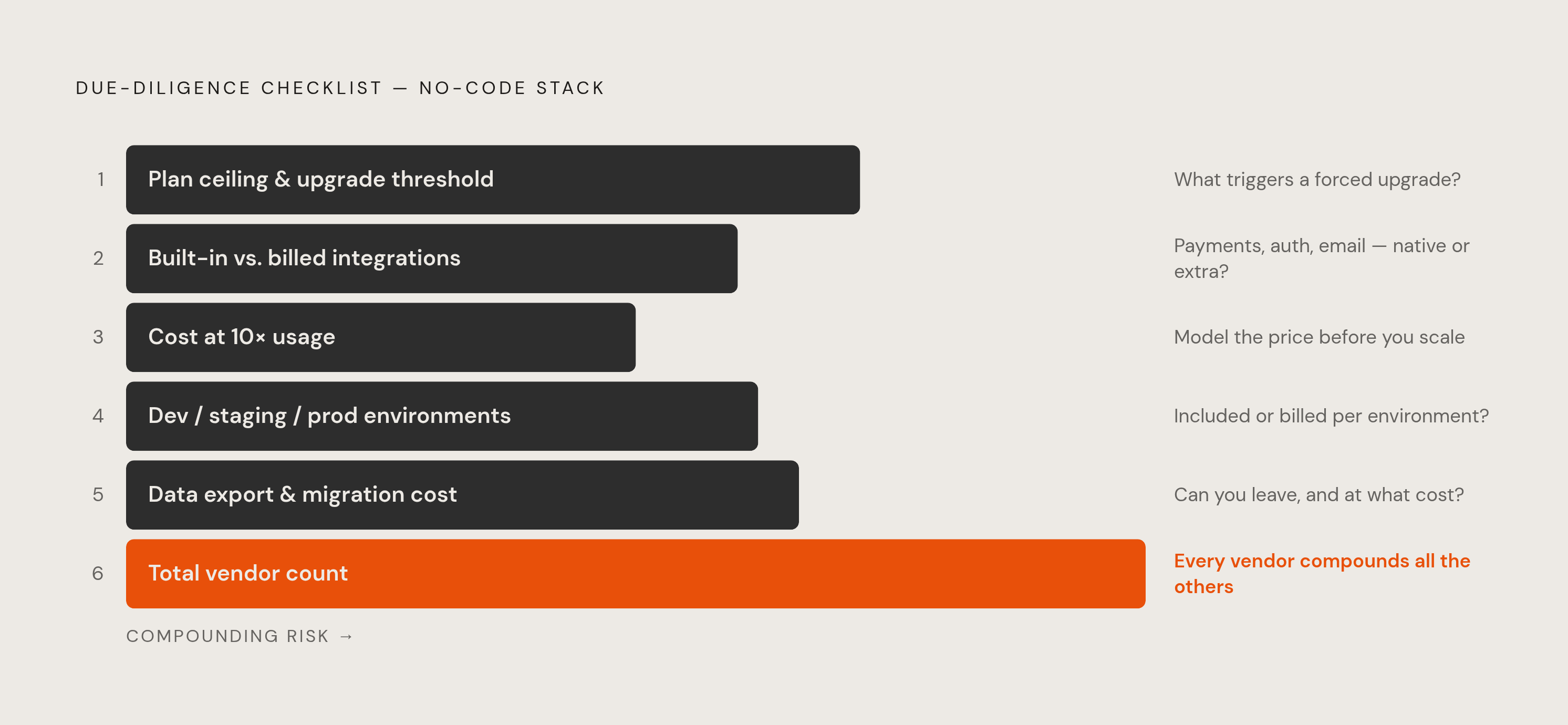
A pricing page only tells a builder the starting number. The real cost of a stack comes from six questions that most platforms are not built to answer up front, and asking them before signing up is the cheapest way to avoid every cost described above.
What's actually included in the base plan versus what's gated above it, and the user count or usage level at which the upgrade stops being optional, is the first question. The second is what integrations a real production workflow needs, payments, login, email, automation, and whether each one is built in, a premium connector, or a brand-new vendor subscription waiting to be discovered later. The third is how the price moves as users, database records, or API calls grow, modeled not at today's usage but at ten times today's usage, since the entry price is almost never the growth price. The fourth is whether separate environments for development, staging, and production are included or billed on top, a charge that a builder typically discovers only once deep into deployment. The fifth is what data export actually looks like and what a migration would cost in practice: if the platform can't give a straight answer, the migration cost should be treated as effectively unlimited until the day a rewrite becomes unavoidable. The sixth is how many vendors the stack depends on in total, since every one of them carries its own update cycle, its own pricing changes, and its own chance of deprecating something a builder depends on, and the maintenance burden scales directly with that count.
Working through all six questions for every vendor in a stitched-together stack is its own kind of job. The alternative is picking infrastructure that already answers them: Floot's all-in-one model bundles backend, database, authentication, email, and hosting into a single flat plan, so the usual questions about connector costs, environment fees, and migration risk are already settled before a builder writes a line. Growth, adding users, scaling data, running more automation, is already covered by infrastructure that was included from the start. What matters is not whether the starting number looks small, but whether the price stays honest as the app, and the business behind it, actually grows.