No-Code App Platforms That Bundle Backend, Database, and Hosting in One Plan
Bundled platforms eliminate integration headaches that plague stitched-together stacks.
Picture the stack a non-technical founder would have assembled as recently as 2022: one tool each for frontend, database, automation, and login. Four subscriptions, four interfaces, four potential breaking points. None of these tools is bad on its own. Each one does its specific job fine in isolation.
The trouble appears in the gaps between them. An auth token expires and nobody notices until a user gets locked out. An API rate limit gets hit during a traffic spike. A schema on one side of the stack drifts from what the other side expects, and suddenly a form submission silently fails. Add separate billing across every vendor, and the founder is running a small integrations department, not one product.
Strip away the drag-and-drop interface, and any no-code platform is doing the same basic thing: generating code the user never sees. A no-code backend, or backend-as-a-service, handles data storage, server logic, authentication, and API access through a visual or conversational interface instead of raw code. That much is true across the category. The real difference between platforms isn't whether they generate code, it's whether what gets generated can survive contact with real users.
The platforms winning in 2026 handle multiple layers well enough that founders don't need to stitch services together.
What "all-in-one" means
"All-in-one" "All-in-one" gets used loosely enough in marketing copy that it must be defined before comparing anything by that name. A genuine all-in-one platform bundles, at minimum, a hosted database, backend logic with working APIs, authentication, and deployment by default, not as extra-cost add-ons. That's the floor. Anything short of that is a partial bundle wearing a full-bundle label.
Plenty of platforms that call themselves all-in-one still leave a gap somewhere. Some handle frontend and hosting well but expect the founder to bring their own database or auth provider. The label survives; the stitching moves rather than disappears.
Bundled versus integrated is the distinction that matters here. Bundled means the pieces share one data model and deploy together as a unit. Integrated means the pieces are connected via APIs, fine until one changes, times out, or gets rate-limited, recreating the same seam described above. Integration is a bridge. Bundling is one building.
Another axis is whether the output is prototype-grade or production-grade. Can the app take real traffic? Can it run background jobs, send a password-reset email, hold real user accounts through peak load?
Then there's whether the platform takes care of scaling and error handling on its own, or the founder still has to configure infrastructure by hand once things get real.
SEO deserves more weight here than it usually gets. Much no-code output ships as a single-page application, which search engines are documented to struggle crawling. Server-side rendering and a working sitemap aren't add-ons after launch; they're infrastructure decisions baked in from day one or absent entirely.
So before comparing any named platform, ask whether it bundles the database, backend, auth, and deployment by default. Is the bundle actually one system or several APIs taped together? Does the output hold up under real traffic, and is it built to be found by search engines from the start?
The stitched-together alternative's costs and requirements
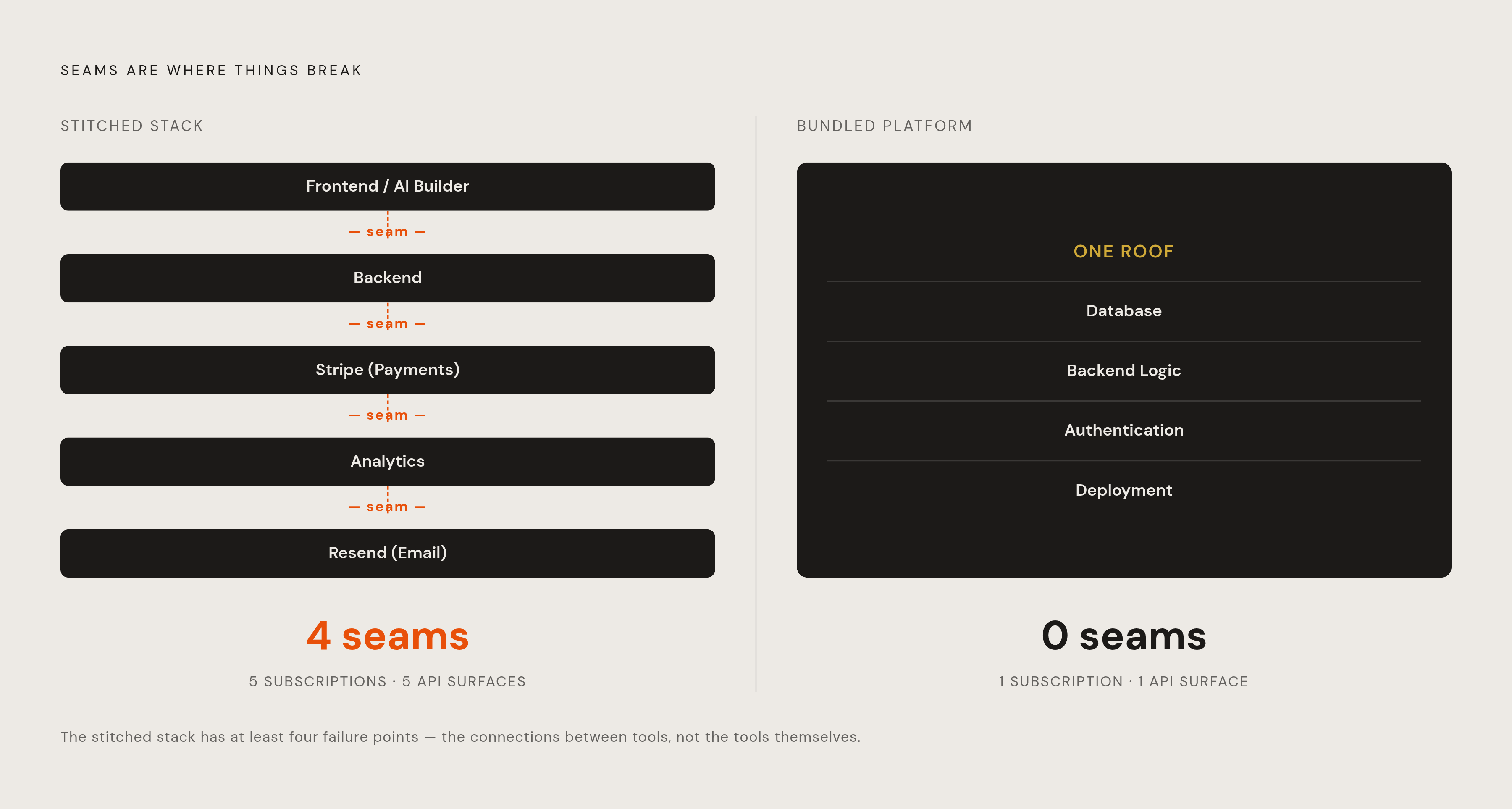
A documented 2026 solo-founder stack pairs a frontend/AI builder, a standalone backend, a payments layer, an analytics tool, and an email service, each with generous free tiers to start. On paper, that's a lean, capital-efficient way to launch.
It's also common. One source surveying indie hacker case studies found this stitched-tool stack in over 60% of reviewed setups. A modern version built on Next.js, Supabase, Stripe, and Resend typically runs tens to low hundreds of dollars monthly, a genuinely reasonable price for a working product.
What this approach gets right shouldn't be waved away. Each specialist tool tends to be best-in-class at its one job, because that's the only job it has to do. Pricing stays transparent and modular: pay for what's used, nothing bundled in that isn't needed. Each vendor also carries its own compliance obligations, so the founder isn't inheriting five sets of regulatory exposure through one shared platform.
What it demands, though, is real and it adds up. Setting up multiple dashboards and wiring APIs together takes real hours, not minutes. Keeping schemas and auth systems compatible across tools must happen manually, repeatedly, every time a tool updates. When something breaks, it breaks at the seams between systems, and those seams are invisible from inside any single no-code interface.
Automation tools like Zapier, Make, or n8n often get pulled in to glue remaining gaps shut, each its own subscription and failure surface. Zapier connects to the widest range of apps, over 9,000 of them, but gets expensive fast at scale. Make tends to cost less per unit of work than Zapier, though multi-step workflows can burn credits fast depending on scenario design. n8n is open-source and can be self-hosted via Docker or a managed host, saving money but shifting operational burden back onto the founder.
None of this appears on the invoice. The real cost isn't the monthly bill, it's the hours spent setting up, maintaining, and debugging it, hours a non-technical founder often can't spare without hiring help.
Standalone no-code backends: what they offer and their limits
Narrow the question down to just the backend layer, and a few tools stand out on their own merits. Supabase is cited as the strongest standalone no-code backend for most projects in 2026: real Postgres underneath, instant generated APIs, and authentication, at a low starting price.
Xano fills a different niche: non-technical founders needing genuinely deep backend logic who are willing to pay for it. Premium plans start at $49/month, with self-hosting available only on a custom tier requiring a sales conversation. Appwrite sits lower, with cloud plans from around $15/month and free self-hosting for anyone willing to run the infrastructure, a real cost saving with real operational work attached.
All three of these are respected, capable tools. None of them is trying to be something it isn't. But none of them ships a frontend builder, so the founder still needs a separate layer to design and display the UI. Deployment and hosting are typically a separate concern from the backend itself. SEO tooling, server-side rendering, sitemap generation, isn't part of what a backend-as-a-service is built to do. Email, push notifications, and recurring background tasks usually mean reaching for yet another integration.
The pattern holds: standalone backends excel at the one layer they own but leave the founder to assemble everything else, the same stitching described before.
An established path: all-in-one by architecture, with a learning curve to match
One established platform has built toward a bundled architecture since 2012, an age reflected in a large plugin marketplace, years of example apps, and a deep, active community that simply takes time to grow.
The bundle includes a drag-and-drop canvas, a workflow engine, a database with custom structures and relationships, and hosting, all under one roof rather than stitched from outside vendors. That's a real, architecturally sound all-in-one setup, not a marketing label stretched over gaps.
An in-editor AI assistant can now generate pages and make changes respecting the app's existing architecture, producing something inspectable and editable rather than a black box. That's a meaningful upgrade over opaque code generation, keeping the founder able to see what the AI actually built.
Founders should note the tradeoff is real too: there's a non-trivial learning curve. Founders aren't just describing what they want in plain language; they're learning the platform's own workflow patterns and conventions, and build speed depends heavily on prior familiarity. There's also no official, first-party MCP connector for Claude or ChatGPT. A community-built MCP server exists on the platform's Data API, but it's third-party rather than company-shipped. It suits founders wanting fine-grained visual control who'll spend real time learning the system for it.
A newer entrant's growth from zero to 250,000 users, and its significance
A newer all-in-one competitor positions itself against platforms still requiring separate hosting, database, or user-management services, bundling database creation, authentication, permissions, and deployment entirely behind the scenes instead.
The growth curve backs the pitch up. The platform went from zero to 250,000 users in six months, with sign-ups arriving fast within the first three weeks. It also turned profitable quickly, pulling in $189,000 revenue in May 2025 despite high AI model costs at the time.
Numbers like that aren't just a company's own success story. They're a market signal. Demand for genuinely bundled infrastructure is large enough to support fast-growing new competitors, not just platforms building since 2012.
The growth curve doesn't answer whether the infrastructure holds up at real production load, or whether pricing stays predictable past the early growth phase. Those are separate questions from adoption, and adoption alone doesn't settle them.
AI-native building with a credit model that adds a second bill
Lovable, a full-stack AI development platform for building, iterating on, and deploying web apps via natural language, has grown past quick prototyping into fuller applications. It's also shipped an official MCP server, letting projects be started or driven from inside Claude or ChatGPT directly.
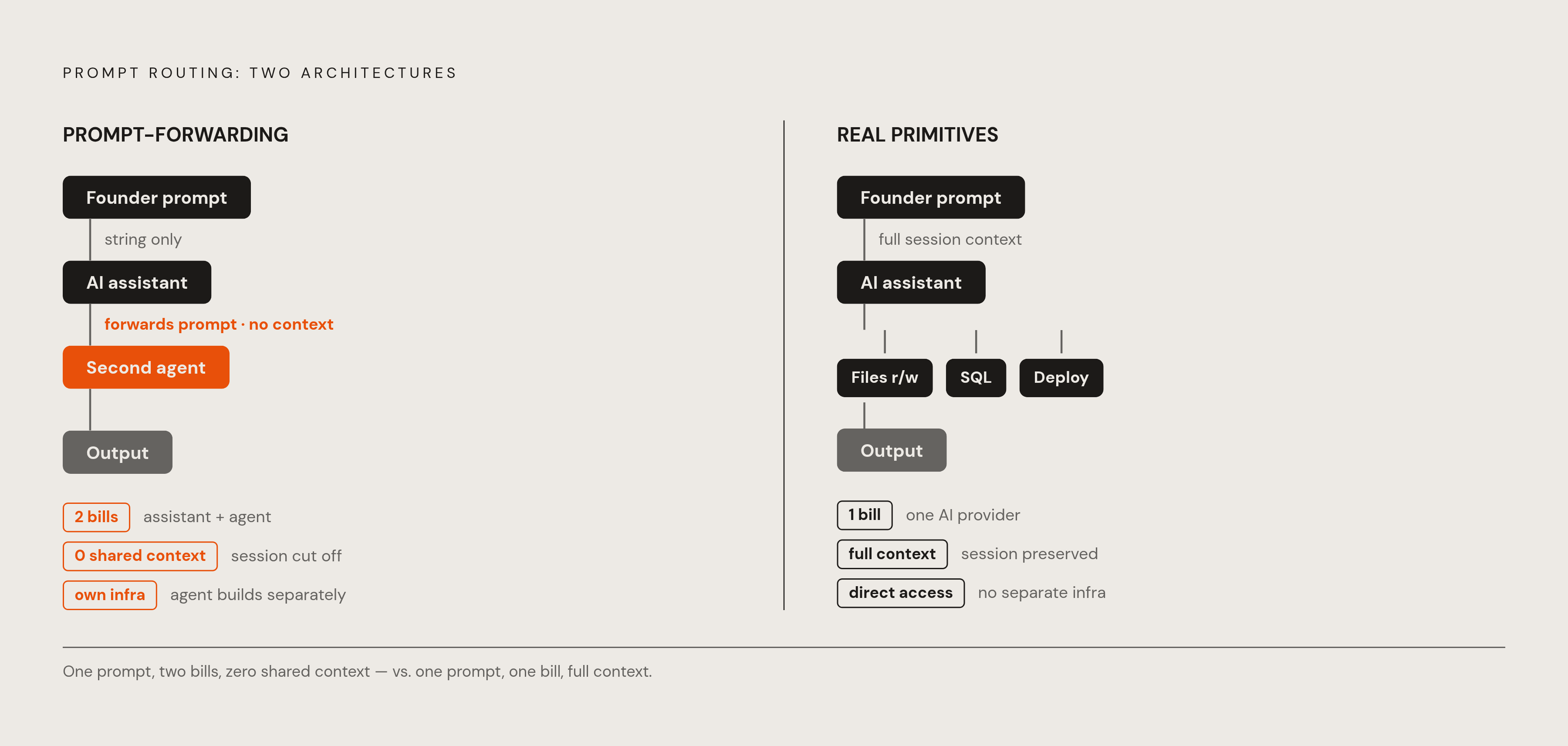
The mechanism behind that connector produces the headline feature, and the build session that follows shows it. A prompt sent through this MCP server gets forwarded to the platform's own agent, which builds on its own infrastructure and spends its own credits. Practically, one build session generates two bills: the existing Claude or ChatGPT subscription, plus credits spent on top.
The credit mechanics compound this. Credits are spent the moment a message is sent, so a rejected output plus a retry costs two credits instead of one. Credit pools reset monthly, so burning through the pool early means either buying more or waiting it out. Reviewers routinely report real spend landing at several times the advertised plan price.
None of that erases what the platform does well. Iteration inside its own chat interface is fast, the platform has scaled meaningfully, and a single vendor-billed subscription is a real convenience for founders preferring one vendor relationship. It suits founders wanting quick iteration inside Lovable's own interface who accept a single vendor subscription, knowing a build triggered from Claude or ChatGPT still spends Lovable credits on top.
Building inside Claude and ChatGPT directly: how MCP connectors change the infrastructure question
Step back from individual platforms for a moment, because the more consequential shift here is structural. The Model Context Protocol, MCP, is an open standard letting any AI assistant connect to any tool or data source through one shared client-server interface, roughly as USB-C lets any device plug into any accessory.
The timeline matters for understanding how settled this standard now is. Anthropic open-sourced MCP in November 2024. OpenAI announced support across its own products in March 2025, starting in the Agents SDK before rolling out more broadly. In December 2025, Anthropic handed governance to the broader ecosystem, making MCP vendor-neutral plumbing rather than one company's proprietary layer.
For a non-technical founder, the AI tool already used daily can become the build interface itself, with no new platform to learn.
Not every MCP connector behaves the same way underneath, and the real question to ask of any is which of those it does. Does the connector hand the AI assistant real primitives, reading and writing files, running SQL, deploying code, letting it reason through the build itself? Or does it just forward the prompt to a separate second agent and bill for that agent's work on top?
The two-agent setup costs more and gives the assistant less to work with. Other active connectors, uploaded files, and earlier conversation context none of it reaches a forwarded agent. Only the prompt string itself gets through. A connector handing over real primitives instead keeps it to one AI bill instead of two, and keeps the assistant's full session context available throughout the build.
What a production-ready all-in-one platform built around MCP bundles
That distinction between forwarding a prompt and handing over real primitives is the design challenge a newer category of connector is built to address. One MCP connector, which debuted on Product Hunt on September 24, 2026, lets founders build and ship full-stack web and mobile apps entirely inside Claude or ChatGPT, database, authentication, and email included, without leaving the chat window.
The bundle underneath makes it worth taking seriously as production infrastructure rather than a demo toy. It includes user authentication with role-based access control built in. It runs backend logic through serverless endpoints rather than a server the founder has to babysit. Hosting runs on AWS with built-in autoscaling, so a traffic spike doesn't crash the app. Custom domains come available on paid plans. Server-side rendering, sitemap.xml, robots.txt, and editable metadata are SEO-ready at publish time with no configuration needed. Recurring background tasks, email notifications, and push notifications round out the list.
The billing model ties back to everything the MCP section laid out. Running the build through Claude or ChatGPT uses the founder's existing AI subscription rather than adding a second bill.