Pay-per-Token AI Pricing vs Flat-Rate Plans for Builders
Token-based AI pricing hits independent developers harder than enterprise teams.

One developer reported their projected monthly Copilot cost rising from €67 to €966 under the token model, a real-world illustration of what the transition looks like in practice. That single case shows what a lot of builders are about to find out the hard way: the era of predictable, flat AI pricing is ending, and the bill for that change doesn't land evenly.
Between November 2025 and June 2026, every major AI vendor rewrote how it charges for usage. Anthropic, OpenAI, Microsoft, and Google all moved from flat per-seat fees to pricing based on token consumption. GitHub Copilot completed that same shift on June 1, 2026, dropping its old "Premium Request Unit" system for GitHub AI Credits, priced at 1 credit per $0.01. Copilot Business still costs $19 a user each month and Copilot Enterprise still costs $39, but both plans now come with a fixed credit allotment, and anything used above that baseline gets billed at published per-token rates.
The range of prices across just one vendor's model lineup shows how hard this is to predict. OpenAI's models span almost three orders of magnitude in cost: GPT-4.1 Nano runs $0.10 per million input tokens and $0.40 per million output tokens, while GPT-5.4 Pro runs $60.00 and $270.00 respectively. A builder who isn't tracking exactly which model handles which call has no real way to predict their bill.
This shift gets plenty of attention at the enterprise level, where finance teams are scrambling to model a new kind of spend. But the sharper, more immediate pain lands somewhere else: on builders running agentic, multi-step workflows, who don't have a finance team to catch the drift and don't have the negotiating leverage that comes with an enterprise contract. The forces driving this shift are structural and well documented. What isn't uniform is who pays the price, and how steep that price gets.
Agentic, multi-step workflows turn token pricing into a compounding penalty
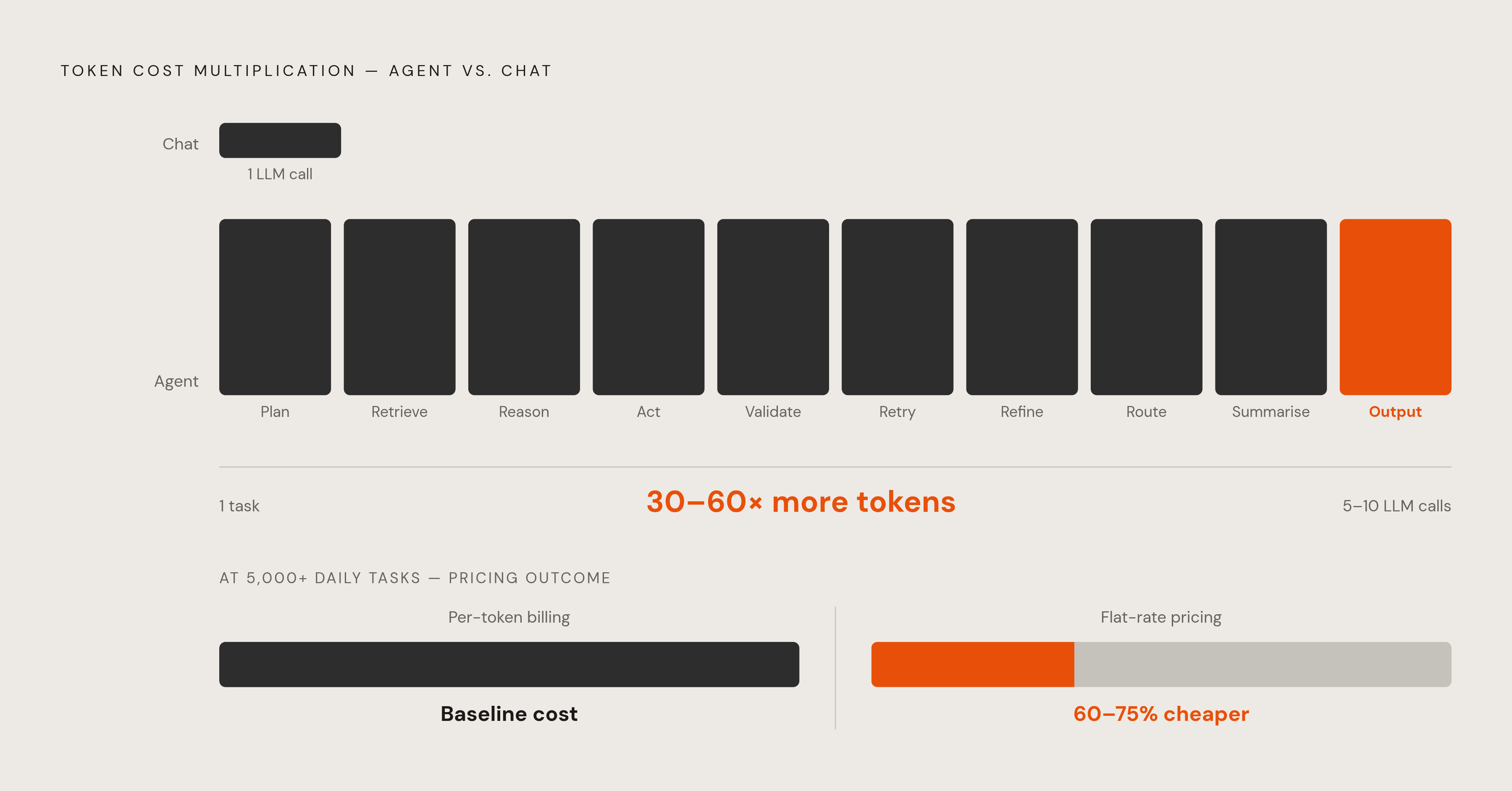
Token pricing punishes agentic workflows in a way it doesn't punish simple chat use, because agentic tasks don't make one call, they make many. Each task in an agentic pipeline spawns multiple LLM calls, and the cost multiplier grows with how complex the workflow gets, not just with how often it runs. That's a different kind of math than a per-seat subscription ever asked anyone to do.
The scale of that difference is stark. AI agents consume 30 to 60 times more tokens per task than the chat tools that came before them, and overall token consumption is climbing at roughly 75% a year. Multi-step chains making 5-10 LLM calls per task execution are standard in production agentic workflows: email processing, customer support triage, and content generation pipelines all fit this pattern. None of that is exotic. It's the baseline architecture for anyone building a real product on top of an AI model.
What makes the cost dangerous is that it stays invisible until it isn't. Token spend doesn't move through the procurement channels that used to catch runaway costs. It scales with engineering decisions made by people who often can't see the budget implications of those decisions in real time, and it appears on an invoice nobody modeled in advance. Even companies with real finance departments have been caught flat: Uber burned through its entire year's AI budget by April, and a healthcare enterprise ran through one trillion tokens over six months before its finance team figured out what was driving the charges.
And providers have no incentive to reverse this. Flat pricing for agentic AI is close to impossible to sustain from the provider's side, which is the whole reason vendors have abandoned it. Builders shouldn't expect any new flat-rate offer from a major model vendor to hold steady for long. If a large company with a dedicated finance team can get blindsided by token spend, a solo builder reading raw usage dashboards with no engineering background stands even less of a chance.
Non-technical builders face a legibility problem on top of a cost problem
Token-based pricing is mathematically fair. It charges for what gets used. For a non-technical builder, tokens don't translate into anything they can plan around. A "seat" or a "monthly request cap" is a number a person can hold in their head and budget against. A token count tied to model choice, context length, and call frequency is not.
That gap matters because the standard advice for controlling token costs, route cheaper tasks to economy-tier models and reserve premium models for tasks that actually need them, requires reading and understanding a codebase. A builder who can't audit their own system's calls has no way to apply that advice. The median business now runs 9 different AI models, the average is 16.5, and companies juggling that many models spend significantly more at scale, largely because of unnecessary routing to premium models for tasks an economy tier could have handled. A non-technical builder has no mechanism to catch or correct that drift before it hits their bill.
Credit-based "flat" plans on no-code platforms promise to solve this legibility problem, and sometimes make it worse instead. Independent pricing audits of major no-code builders in 2026 found that credit consumption on some platforms runs 4-6x estimates, making the realistic multi-month cost far higher than the advertised entry price. One head-to-head comparison found a platform advertised at $25 a month actually cost $1,850 over six months in practice, a gap far too large to call a rounding error. When the platform controls both the token metering and the infrastructure pricing, a builder has no independent way to check whether the number on the invoice matches the number they were promised.
Where the cost crossover happens for production workloads
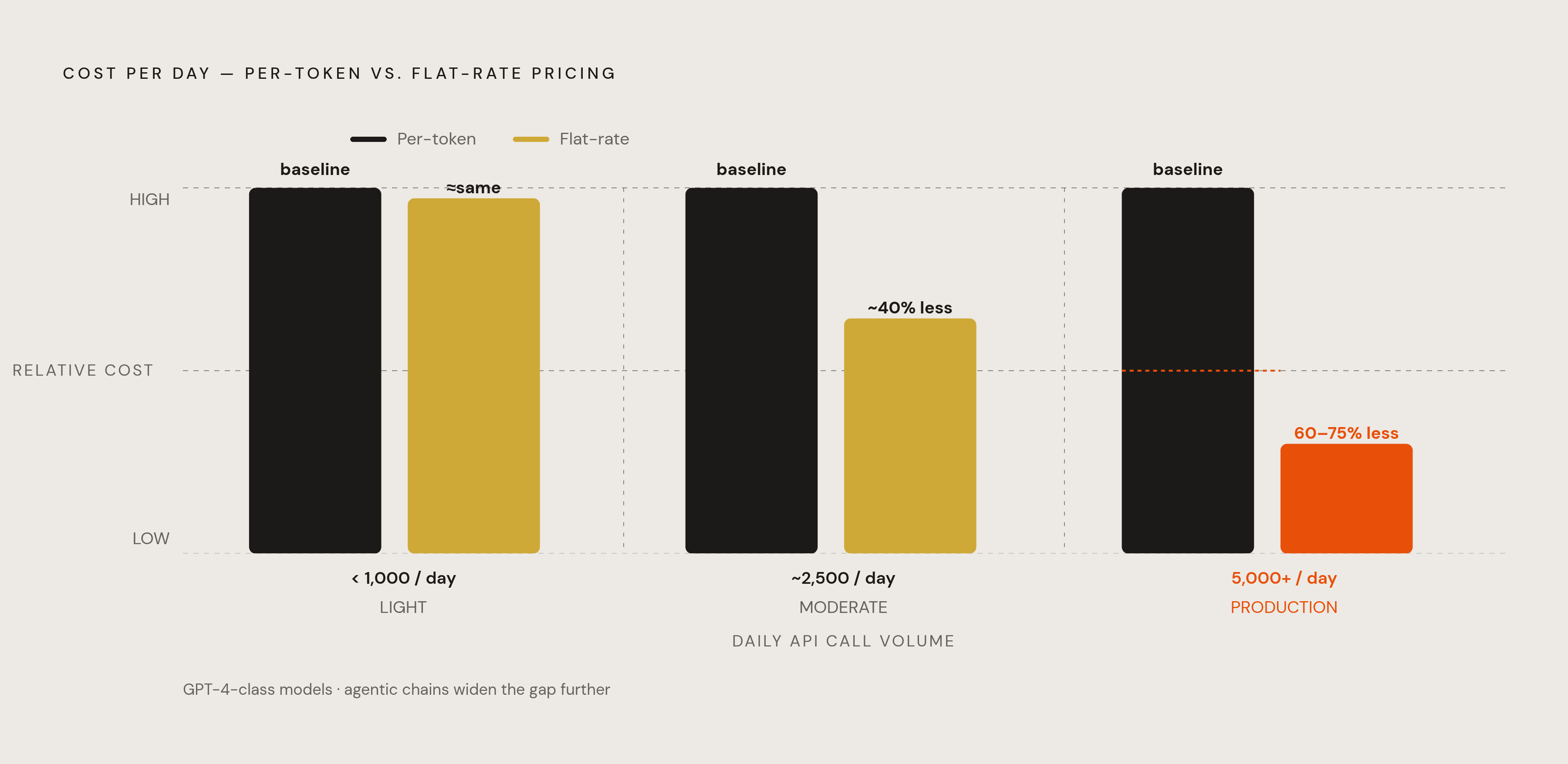
Flat-rate pricing produces a measurable advantage over per-token billing once usage climbs, and the numbers show where it starts winning by a wide margin.
At light usage, under roughly 1,000 API calls a day, per-token billing and flat-rate pricing cost roughly the same. Past that, the gap opens fast. At 5,000 or more daily calls, the volume typical of production workflows handling email processing, customer support triage, or content generation, flat-rate pricing runs 60 to 75% cheaper than equivalent per-token billing on GPT-4-class models.
Multi-step agentic chains push that gap even further. Multi-step agentic chains push that gap into the line between a business that survives its own infrastructure costs and one that doesn't.
Every one of these numbers describes a normal, working production app, not some hyperscale edge case. A customer support bot, a content pipeline, an email automation system, these are the exact shapes of app that most builders are trying to ship. The crossover into flat-rate advantage comes from running an agentic architecture at all, not from reaching enterprise scale. It's a question of running an agentic architecture at all, which is precisely the architecture more and more builders are adopting.
The "bring your own AI" objection deserves a real answer
There's a fair challenge to raise here: if a platform lets a builder "bring their own AI" by connecting their existing Claude or ChatGPT subscription, doesn't that just move the token cost somewhere else instead of eliminating it? The cost is embedded in whatever the builder already pays their AI provider, and a builder running heavy usage can hit their subscription's rate limits before their app even scales. That's a real constraint, and it deserves a straight answer rather than a dismissal.
Bring your own AI" models don't make token costs disappear. What they do is separate token costs from infrastructure costs, and that separation is the structural change that matters. Under this model, the builder pays Anthropic or OpenAI directly for their token consumption, at whatever rate they negotiated or subscribed to, with no markup layer added on top by the platform. The infrastructure itself, hosting, backend, database, authentication, email, SEO, gets priced separately, and flatly.
That separation removes the mechanism by which platforms mark up token costs invisibly, since the documented pattern of credit consumption running 4-6x estimates on some no-code platforms is only possible when the platform controls both the infrastructure and the token metering. Those overruns were only possible because a single platform controlled both the infrastructure and the token metering at once, giving itself room to mark up usage invisibly.
The rate-limit risk affects a narrow slice of builders and shouldn't be waved away. But it affects a narrow slice of builders, mostly the ones already scaling past early and mid-stage usage, and it only becomes relevant at the point where a dedicated API contract is already the right move for that builder anyway. For the builder still finding product-market fit, separating token costs from infrastructure costs solves the actual problem in front of them.
What production-grade infrastructure requires beyond the AI model itself
None of this pricing analysis matters if the platform underneath a builder's app can't actually support something real, growing, and in front of users. Most no-code and AI-builder tools hand the hardest infrastructure work back to the builder: backend logic, database design, authentication, hosting, and integrations all have to get wired together separately.
A production-grade stack needs backend logic, database storage, user authentication, recurring background tasks, email notifications, SEO, and hosting that can scale with real traffic. None of that comes from the AI model itself. Every piece has to be built, integrated, or bought, one way or another, if the platform in front of the builder doesn't already include it.
That number holds only when every one of those services is configured correctly, maintained over time, and running at base rates.
A stack stitched together from five or six separate services carries real cost when something goes wrong for a builder without an engineering background. It's fragile. Every added integration is one more thing that can silently break, one more vendor relationship to manage, one more bill to reconcile. A platform that handles infrastructure automatically and prices it flatly solves both problems: unpredictable costs and fragile infrastructure at once.
How MCP-based all-in-one infrastructure changes pricing and deployment
Zapier's MCP server gives an AI client managed access to more than 9,000 apps, complete with authentication and permissions already handled. That's the clearest sign yet that MCP-based connectors have become the standard route for extending what an AI system can actually do, plugging it into real business tools and workflows, without requiring a builder to write integration code by hand.
That said, the MCP client landscape isn't uniform, and builders need to understand where the friction sits. Every client implements the protocol a little differently. ChatGPT requires OAuth 2.1, plus bearer tokens or session-based authentication, for any MCP server it connects to that needs credentials. Claude handles authentication through its own separate approach. Cursor relies on local configuration files instead of either. For any team that doesn't want to get locked into a single AI tool, sorting out multi-client support becomes the main integration challenge they'll face.
This is where the pricing argument and the infrastructure argument finally meet. An all-in-one platform built around MCP connectors can hand a builder managed access to thousands of integrations, backend logic, authentication, hosting, and the rest of the production stack, all under one flat infrastructure price, while keeping token costs separate and billed directly to whichever AI provider the builder already uses. That's the structural fix this entire piece has been building toward: token costs stay legible because they're paid directly to the model provider at the provider's own rate, and infrastructure costs stay flat and predictable because they sit on a completely separate bill. A builder running an agentic, multi-step workflow no longer has to choose between an unpredictable per-token invoice and a black-box credit system, since token spend sits outside traditional procurement frameworks, scales with engineering decisions made by people with limited budget visibility, and arrives as a surprise on an invoice that nobody modeled. The architecture that got builders into this cost problem in the first place, agentic workflows multiplying calls across complex chains, is the same architecture MCP-based infrastructure was built to support without punishing the builder for using it.