App Building Platforms With Built-In SEO, Analytics, and Custom Domain Support
Built-in SEO and analytics solve the infrastructure gap between demo and real product.

Most non-technical founders find out the hard way: the app is built, the demo looks great, and then someone asks where the site actually lives, and that question is where the gap between demo and product appears. The AI wrote working front-end code in an afternoon, but the database, hosting, authentication, and search indexing are still sitting there unsolved. Floot itself frames the issue this way: ChatGPT and Claude can already write an app, but the real chore comes afterward, wiring together git, Vercel, Supabase, Resend, and similar services. Getting the thing live means wiring together git, a hosting service, a database provider, and an email tool, each one a separate signup.
For someone who doesn't code, that's not a minor chore. Every added service is a new account, a new bill, a new way for something to break quietly in the background. SEO, analytics, and custom domains tend to land at the bottom of that list, treated as extras to bolt on once the "real" work is done. Founders usually don't notice the gap until they need traffic and realize nothing is set up to bring it in.
A working prototype and a real product are different things. A shareable link proves the app runs. A product needs a domain, needs to show up in search results, and needs numbers a founder can actually look at. None of that exists by default on a platform subdomain with no indexing set up. For anyone whose growth plan depends on people finding the app through Google rather than a link someone sends them, that gap decides whether the thing is a business or just a demo.
Client-Side Rendering, the Default for Most Builders
The single biggest technical fork in the road, for anyone who cares about search traffic, is where the app's content gets built: on the server before it reaches the browser, or in the browser after the page loads. That distinction sounds abstract until you picture what Google's crawler actually sees.
When Googlebot hits a client-side rendered app, a single-page application built the way most modern web tools default to, the raw page it grabs first is close to empty. The content appears only after JavaScript runs in the browser, and while Google eventually runs that JavaScript through its own rendering system, that step gets queued and delayed, sometimes by hours, sometimes by weeks. Googlebot first indexes the raw HTML, which on a client-side rendered app is essentially empty, then queues the page for a separate rendering pass, and while Google has reduced that delay since 2020, the lag still creates timing issues for fresh content and JS errors can silently kill indexing altogether. Indexing stalls behind that queue.
Server-side rendering lets the server build the full page, text and all, before sending it out, so a crawler reads real content on the first pass instead of waiting for a script to run.
Most AI app builders default to the client-side approach because it's quicker to generate and simpler to ship. The cost appears later, well after launch, once the founder has already committed to the platform. None of this means single-page apps are a mistake: they're the right call for plenty of products. The trouble starts when a founder picks an SPA-first builder while expecting the app to show up in Googlec7. And once that mismatch exists, there's no quick patch for it. Fixing it means starting on a platform built with server-side rendering from day one, or tearing apart the existing app's architecture.
Two smaller pieces matter for the same reason. Sitemaps and robots.txt files tell search engines which pages exist and which ones to bother crawling, and most AI-generated apps don't generate either one on their own. Canonical URLs tell Google which version of a page counts when the same content sits at more than one address. Google won't slap a formal penalty on ordinary duplication, but without a canonical tag, ranking signals get split across URLs and the wrong one can end up as the indexed version. Founders tend to discover this only after rankings have already taken the hit.
Complete built-in SEO infrastructure, beyond the meta tags checklist
Meta title, meta description, a social preview image: most platforms hang their entire SEO pitch on these three things. They're real, but they're the surface layer. The infrastructure underneath a page determines its ranking.
A platform can hand a founder perfect meta tags and still leave the content invisible if there's no server-side rendering behind it. Labeling a page correctly means nothing if the page itself never reaches the crawler. Speed belongs on this list because Google scores page speed directly, and edge delivery, hosting quality, and caching all feed into that score.
Analytics deserve a spot on the checklist for a specific reason: they close the loop on everything else. A founder doing the SEO work still needs to know if it's converting into actual visits, and bolting on a third-party tracking script to find out adds page-load weight and, depending on where the users are, privacy compliance headaches. Built-in analytics answer the question without the extra baggage.
Custom domains round out the list, and they carry more weight than "looks more professional." A branded domain is a trust signal to users, sure, but it's also the thing Google needs in order to attach accumulated search authority to a specific brand. Custom domain setup on the platform automatically handles canonical URLs under the hood as well, aiming to prevent duplicate content penalties from search engines. Every month an app sits on a platform's shared subdomain, any link equity or search history it builds stays stuck there. Moving to a custom domain later means none of it carries over.
The all-in-one versus stitched-stack choice for SEO and domains
Once that standard is on the table, the decision between one all-in-one platform and a stitched-together stack of separate tools turns into a practical question: how many services need to be configured right and kept in sync, and who notices when one of them slips.
The 2026 indie-hacker stack that gets recommended often includes a front-end builder, a data-and-auth service, a separate analytics tool, and standalone email and payment providers. That configuration spreads SEO responsibility across every one of those vendors. Server-side rendering depends on the front-end builder's own architecture, analytics lives in its own account, and custom domains might get configured somewhere else entirely. Every seam between those tools can quietly break: a CDN setting can bypass rendering, a tracking script can slow the page down, or a domain redirect can wipe out a canonical URL assignment.
A technical founder can diagnose those failures fast, and at small scale, the stitched stack is often the cheaper route. A non-technical founder lacks that diagnostic advantage, so a silent SEO failure in that setup can run for months before anyone notices the traffic never showed up.
There's a useful, well-documented example of where the all-in-one promise runs into a wall. A well-known no-code website platform handles SEO for marketing sites competently. Ask it to store user data, run server-side validation, or support multiple logged-in users, though, and the platform needs outside help: membership tools, backend databases, data-sync layers run through automation software. At that point the founder is managing several platforms anyway, and SEO configuration is scattered across all of them. The moment that site needs a real backend, its all-in-one pitch has already fallen apart.
That's exactly where the case for an all-in-one platform gets strongest for SEO-dependent products. When one platform owns rendering strategy, domain routing, sitemap generation, analytics, and hosting, all of it gets configured once and tested together. A change in one part doesn't silently break another somewhere else.
Platforms That Include SEO, Analytics, and Custom Domains by Default
Measured against the full standard, server-side rendering, sitemaps and robots.txt, canonical URLs, meta tags and social previews, built-in analytics, fast hosting, and custom domains, the platforms marketing SEO capability turn out to deliver very different things once you look past the pitch.
One platform includes custom domains starting on its Pro plan at $25 a month, with a Free tier below it and a Power tier above adding higher usage limits and more hosting room. The same platform launched an MCP connector, which debuted on Product Hunt on September 24, 2026, that lets founders build and iterate directly inside Claude or ChatGPT, applying the full SEO infrastructure automatically to every app generated through that connector, with no additional configuration required. A review of the platform from 101 AI Tools, last verified in August 2026, was published that same month.
Base44 offers an official hosted MCP server for driving its builder from Claude, Cursor, or ChatGPT on its Builder plan and above, a per-app MCP feature that exposes an app's own data to an assistant, and the ability to pull in outside MCP servers from within its own chat. Its SEO and hosting details vary by plan, and the sources available don't confirm its server-side rendering support in enough detail to say whether it matches the full standard. Billing runs on a message-credit and integration-credit system rather than a daily action cap, positioning it more toward apps, websites, and agents built through a credit meter.
Lovable is named in the best AI app builders comparison as part of the competitive field, and the research brief notes one Product Hunt reviewer spent eight months with Lovable dealing with recurring errors before switching platforms. Available sources don't establish where Lovable currently stands on server-side rendering or the rest of the SEO standard, a detail to confirm independently before betting a search-dependent product on it.
Replit is a browser-based platform with an AI agent that builds, tests, and deploys across more than 50 programming languages, and it leans on the user to fix things when something breaks, which is a real obstacle for anyone without a coding background. The research brief's most concrete data point on Replit is the pricing risk: SaaStr founder Jason Lemkin accumulated hundreds of dollars in additional charges over just a few days on the Core plan, with compute, storage, and AI Agent usage all drawing from a unified credit wallet, and pay-as-you-go overages charged on top of the base subscription. Nothing in the available material establishes Replit's built-in SEO setup, so it reads as a platform built for developers first, not one optimized for a product that needs to be found through search.
Bolt builds full-stack apps from natural language, runs inside the browser through WebContainer technology, deploys to Netlify with GitHub syncing, and supports frameworks including React, Next.js, Vue, Svelte, Astro, and Remix, with Node.js handling the backend inside the same WebContainer setup. Its V2 update added a cloud layer with built-in databases, authentication, hosting, file storage, edge functions, payments, SEO, and analytics. It's also been flagged for missing deeper architectural problems and for burning through tokens fast on complex projects, worth factoring in for anyone planning a long stretch of iteration. As with Lovable and Replit, nothing available confirms Bolt's server-side rendering status closely enough to measure it against the full standard.
Connector-based infrastructure and the SEO equation for non-technical founders
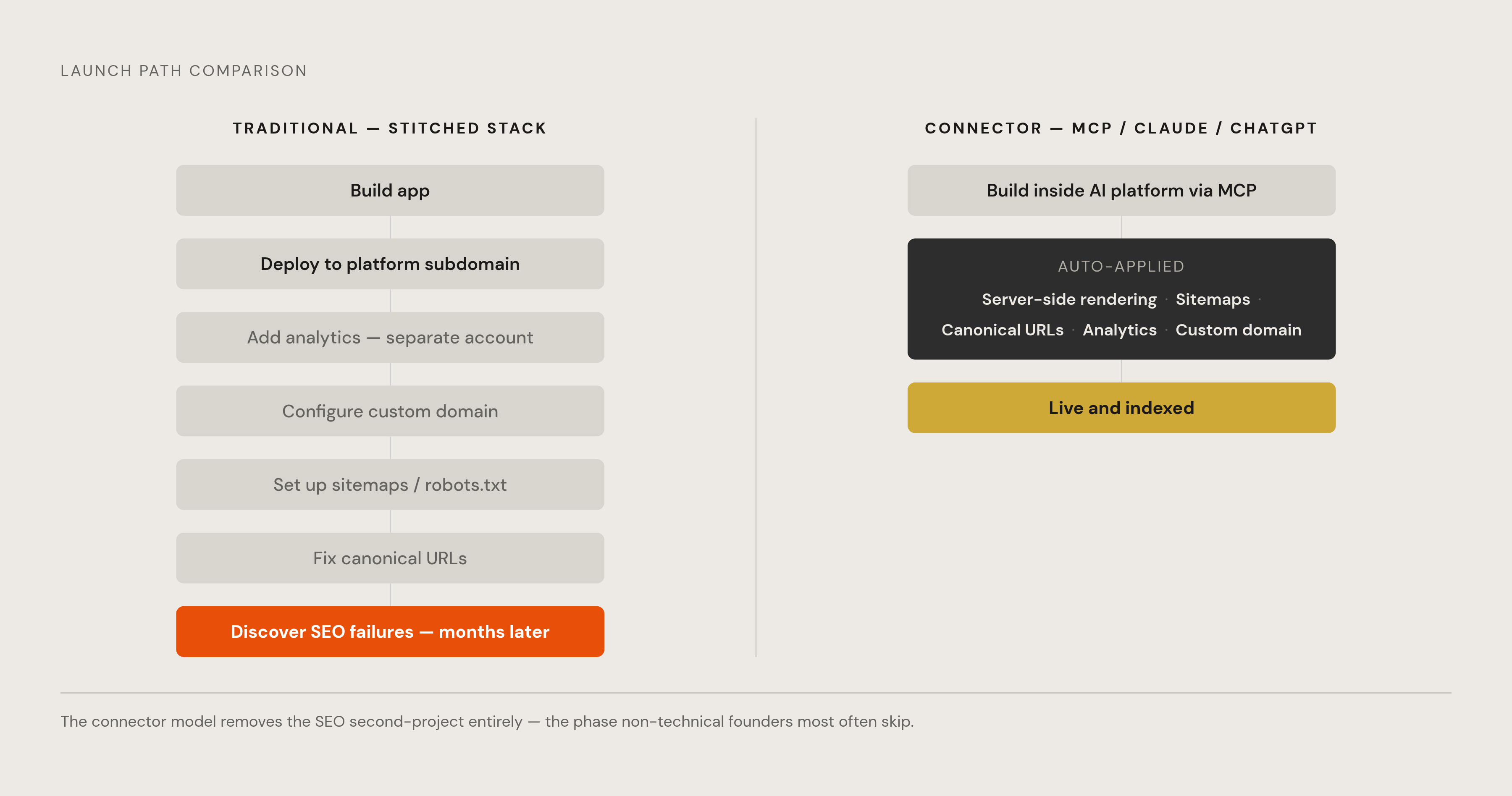
The MCP connector model flips the order of operations. The founder builds inside the AI assistant they already use, Claude or ChatGPT, and a connector handles the infrastructure underneath without a separate deployment step. That shifts who's responsible for SEO and when it gets applied.
Compare that to the traditional sequence: build the app, launch it, then go back and wire up rendering, sitemaps, domains, and analytics as a second project after the fact. That second project is exactly where founders lose months, because it requires knowing what to ask for in the first place. A connector that applies full SEO infrastructure automatically to every app it generates removes that step entirely: there's no post-launch configuration phase where a non-technical founder has to know that server-side rendering and canonical URLs are things to ask about. The infrastructure comes with the build, not after it.
Sources
- Best AI App Builders for Non-Technical Founders in 2026 - Floot
- Floot vs Base44: Which AI App Builder Is Better in 2026? - Floot
- AI App SEO — Build Crawlable Apps with Floot - Floot
- Floot Review 2026: AI App Builder With Built-In SEO | 101 AI Tools
- Floot: Build and ship web and mobile apps inside Claude or ChatGPT | Product Hunt
- Floot vs Bolt: Which AI App Builder Is Better in 2026?