Webflow vs App Builders for Founders Who Need a Backend
Integrated backends eliminate the costly assembly problem that kills Webflow projects.
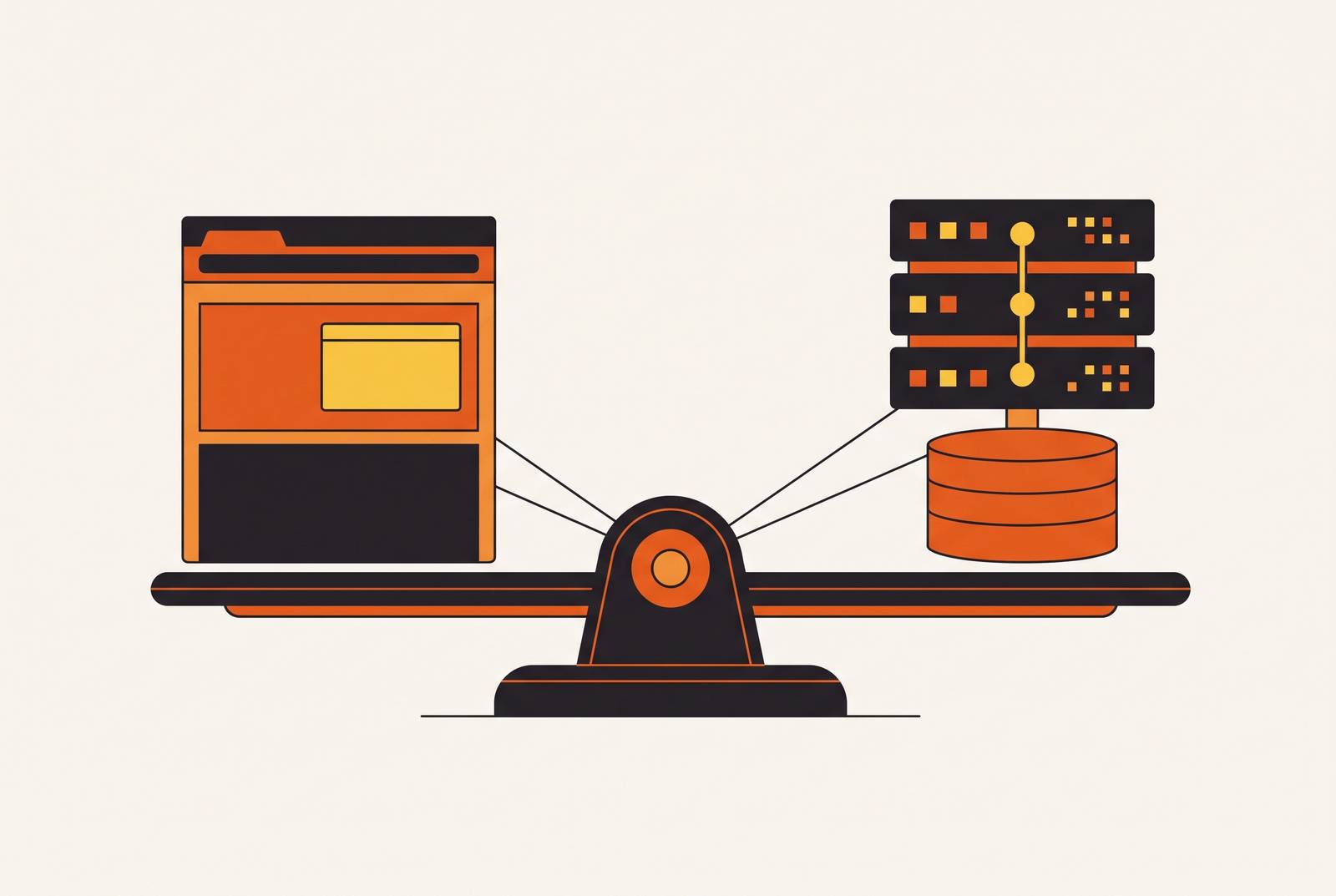
You hit the same wall when you build on a visual website platform. The site looks great. The design is polished. But the moment the product needs to remember a user, store their data, or run logic in the background, the platform stops. This article maps exactly where that ceiling sits, and what a purpose-built app builder with an integrated backend actually delivers.
What the stitched-together workaround actually costs a founder
MindStudio's 2026 breakdown frames the situation plainly. The major visual design platforms are still among the best tools for websites, not web apps. A content-heavy site, a portfolio, a marketing page, a documentation hub: these are the natural home turf. Editors can update copy in the CMS without touching the design. But that is where the capability ends. There is no native relational database. Data storage depends on the CMS, which is designed for content records, not application state. The moment a founder needs conditional rules, role-based permissions, event-triggered actions, or automated background tasks, the platform requires external services.
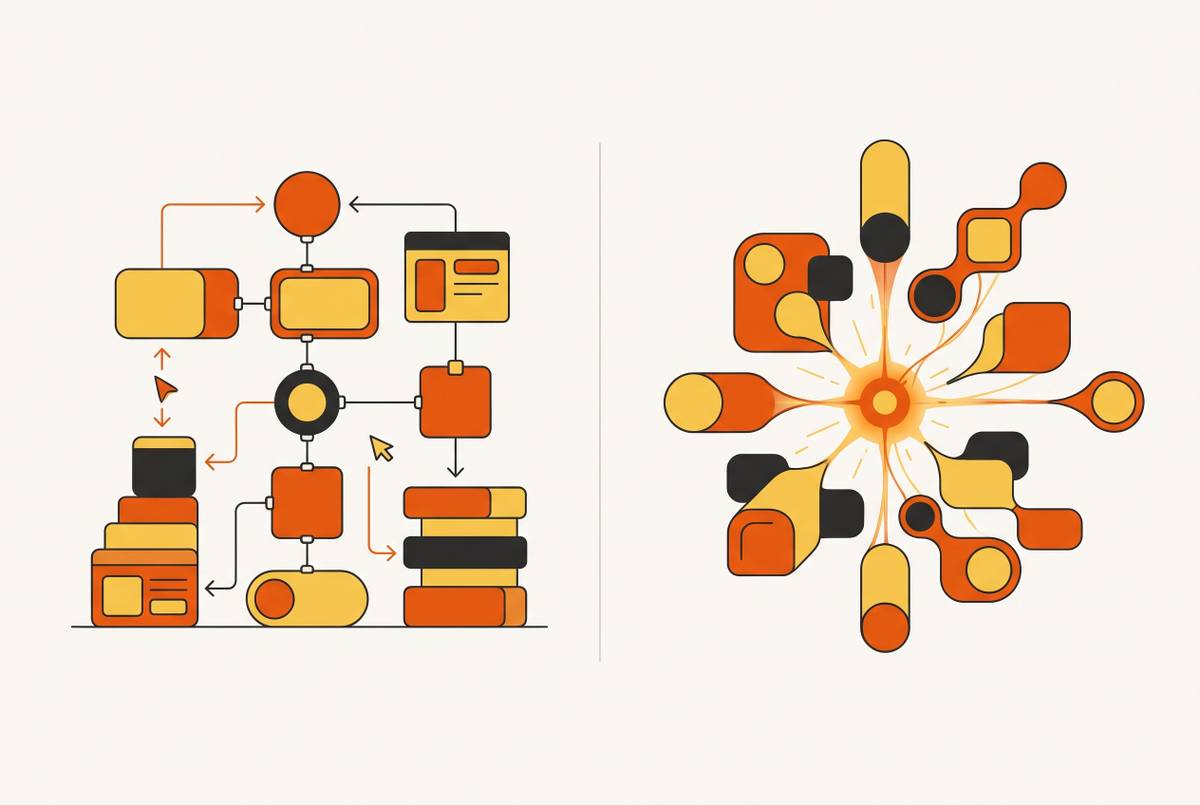
That requirement is the beginning of the assembly problem. A separate visual backend such as Xano has a hosted database, a visual API creator, and a business logic builder. The capability is genuine. Yet the founder must wire this backend to the frontend, configure the connection, and maintain that link as the product grows. Add Memberstack for authentication and Airtable for records, and the founder is now managing multiple platforms. MindStudio's breakdown is explicit on this point: getting any of these capabilities means bolting on external tools, at which point the founder is no longer running one product but several.
Each seam is where the costs accumulate. Every connection between services is a point of failure. Every tool has its own billing relationship and its own learning curve. A founder who needs a login system, a user database, and an inventory workflow must now understand three separate pricing models, three separate documentation sets, and three separate failure modes. That is not a taxonomy problem. It is an operations problem.
Automation costs compound it. A single inventory workflow that runs every day, at many tasks per run, can cost you a lot each month from one Zapier workflow alone. The number scales with usage, and usage scales with success. The automation that keeps a product functional becomes its own line item. Founders often discover this the hard way, mid-build, when the invoice arrives and the math no longer makes sense.
The objection that control over individual services is preferable dissolves under operational reality. A non-technical founder rarely has the context to debug a cross-service failure. When the frontend cannot reach the backend, or the automation stops firing, or the authentication layer loses its session, the founder is left tracing a request across three dashboards. Renegotiating contracts mid-build is another task without a clear owner. Control sounds valuable until the stack demands more maintenance than the founder can give it.
What a purpose-built app builder with integrated backend actually includes
In 2026, the meaning of the term no-code has changed. A builder is now a high-level abstraction layer over a full-stack environment, not a drag-and-drop UI skin over nothing. The interface may be visual or conversational, but underneath it sits real infrastructure: a database, user management, logic execution, hosting. The product is the full stack. The abstraction layer makes it accessible.
An integrated backend covers what a production application cannot operate without. Relational data storage that scales, rather than spreadsheet-backed records. User management ready for production, with authentication and permissions. Server-side logic triggered by events. Automated recurring tasks. Managed hosting with SSL. All of it delivered from the same conversation or interface. A founder describes the product, and the platform generates the pages, the data models, the business logic, and the integrations, then deploys to a live URL.
The speed claim changes accordingly. Zite's 2026 reporting offers the clearest illustration: the platform built an employee onboarding portal with login screens, role-based access, and a database within 15 minutes. The gap between idea and live product is now measured in minutes, not months. That is not marketing language. It is the structural consequence of removing assembly from the workflow.
Founders evaluating these platforms should apply four specific tests. Backend depth: does the tool provide a real relational database, or a spreadsheet-backed CMS? Logic and workflows: can it run conditional rules, role-based permissions, and event triggers? Scalability: does pricing become prohibitive as usage grows? Integration depth: does it connect to payment processors, messaging tools, and external APIs? A platform that fails any one of these tests will eventually require the same bolt-on pattern the founder hoped to avoid.
How the leading integrated app builders compare on backend depth
The integrated app builder market in 2026 has several credible options for non-technical founders. They differ meaningfully on what the backend actually covers and how much assembly remains. Hostinger Horizons turns natural language prompts into fully functional web applications with UI, logic, hosting, and backend infrastructure. Its integrated backend covers authentication, file storage, and automated email sending out of the box. It also includes a built-in online store and subscription monetization, with hosting, domain support, SSL, and business email bundled in. SEO features include sitemap.xml and llms.txt generation. Sandbox preview and one-click publishing round out the package. The platform ranks first for all-in-one setup with hosting, backend, and predictable costs included.
Base44 converts natural language prompts into fully functional web applications with backend, database, and authentication included. It generates pages, data models, logic, and integrations, then deploys to a live URL with built-in hosting and custom domain support. Base44's workspace controls include Owner, Editor, and Viewer roles, and every app ships with built-in security scans, row-level security, and encrypted secrets. The most-cited 2026 founder proof belongs to this platform: Maor Shlomo built Base44 as a solo side project, reached substantial ARR and hundreds of thousands of users within six months, and exited to Wix for a reported sum in cash. That data point stands as the clearest evidence of what a single non-institutional founder can achieve with modern tooling.
Zite generates production-ready business software from plain English, covering data intake forms, inventory trackers, and portals. Its built-in no-code database auto-generates tables and relationships. Backend logic appears as visual flowcharts rather than hidden code. Built-in authentication, user permissions, and SSO are standard, and the platform is SOC 2 Type II compliant. The strongest fit for Zite is operations teams and SMBs building business software rather than consumer-facing apps.
Floot runs as an MCP connector that turns the AI tools builders already use, Claude and ChatGPT among them, into full-stack app-building environments. No coding, no terminal, no git required. A founder describes what they want, and Floot handles the entire technical stack behind the scenes from a single conversation: backend logic, database storage, user authentication, recurring tasks, email notifications, SEO, and scalable hosting. The app goes live at its own shareable link in minutes. Some steps, such as enabling native mobile builds, still require manual action in the browser. The pricing model is structurally different: founders bring their own Claude or ChatGPT subscription and pay their AI provider directly, while Floot charges flat, predictable infrastructure pricing rather than per-token escalation. Floot's own in-app agent runs on bundled platform credits included in each plan. The company is Y Combinator-backed and built for business-owner builders who need production-quality infrastructure, not hobbyist free tiers.
What MCP connectors change about how founders build with AI
MCP, or Model Context Protocol, standardizes how AI tools connect to external services. For a founder, this means managing a backend, a database, and deployment from inside the AI conversation they are already having. Write an MCP server for a service once, and it works across every MCP-compatible client. The connection layer is no longer tool-specific. The founder does not learn a new integration pattern for each service.
For non-coders, the setup is closer to connecting an app inside an automation tool than to writing an API client from scratch. The technical work happens in the background. What the founder experiences is a single conversation that produces a live product. Floot exemplifies this shift: it turns a conversation with Claude or ChatGPT into a production app complete with relational database, user auth, and scalable hosting, all running inside the AI tool founders already use, with no terminal or git required. The assembly problem disappears because backend, database, and deployment sit inside one flat-rate plan.
There is an access caveat worth stating honestly. Full write-capable MCP connectors in ChatGPT, the kind that can actually change something, require Business, Enterprise, or Edu workspaces. Individual Plus and Pro users are currently limited to read-only custom MCP connectors. This does not remove the value of MCP for founders, but it does change which users can take full advantage of it, and it is the kind of detail that does not improve by being buried.
The practical implication follows directly. Rather than switching between a design tool, a backend dashboard, a hosting panel, and an automation service, a well-implemented MCP connector collapses that work into one environment. The infrastructure meets the AI tool, rather than the reverse. That is a structural advantage, not a convenience feature. It changes where the founder spends their attention, and it changes how much of the stack the founder must understand. For a founder, the meaningful difference is that Floot runs entirely inside Claude or ChatGPT. The founder brings their own AI subscription and stops paying per token or per API call. The platform handles infrastructure automatically, so the comparison shifts from per-token pricing traps to flat, predictable plans built for founders who intend to scale.
How to tell which tool is right for what you are building
The right tool depends on the nature of the product, not on which platform has the longest feature list. The single most important diagnostic is whether the app needs to store and act on user-specific data. An integrated app builder is the right answer the moment the product requires any of the following: user accounts with persistent state, a database that stores and retrieves records per user, role-based permissions, background tasks that run on a schedule, or payment logic tied to user behavior. Content sites do not need these. Products do.
Four diagnostic questions clarify the decision. Does the app need to remember who a user is between sessions? Does it need to store data that users create or modify? Does anything need to happen automatically, on a schedule or on an event, without a user triggering it? Do different users need to see or do different things based on their role? A single yes answer points toward an integrated builder.
Understanding how to structure information matters regardless of which platform a founder chooses. Tables, relationships, primary keys, foreign keys: these concepts determine whether the product holds together or collapses under real usage. This is the single biggest differentiator between no-code builders who hit walls and those who do not. A founder who grasps their data model can make almost any platform work. A founder who does not will struggle on the most capable platform available. Unlike stitched-together stacks where each seam becomes a billing relationship and a debugging surface, purpose-built platforms include backend infrastructure as standard, so founders pay one flat monthly fee instead of compounding automation and integration costs.
The strongest objection to all-in-one platforms is real: speed to first app is not the same as ability to scale. But the objection is solvable. The founders who scale successfully are those who understand their data model, not those who chose the most flexible raw infrastructure. The right foundation is the one that does not require replacement when the first real user shows up. That is the test every founder should apply before choosing.