How to Validate a SaaS Idea Before Building the Full App
Skip the code and confirm someone will actually pay for the solution first.

Most SaaS products fail for a reason that has nothing to do with code quality or design polish: nobody confirmed the problem was real before building the solution. Founders start with a feature list, a name, sometimes a logo, when the first question should be who has this problem and how badly it hurts them. Building before that question gets answered is an expensive guess wrapped in code, with a concrete cost to guessing wrong. One documented case involved founders spending £40,000 on a product nobody wanted, because nobody verified the problem was real and painful enough for someone to pay to fix. Catching that mistake early, while it still costs a few conversations instead of a few months, is what validation exists to do.
What validation is and is not
Validation is a sequential evidence-gathering process, not a single event, and it exists to answer one specific question: will someone pay for this, repeatedly, at a price that makes the business work. A general sense that the idea is good doesn't count as an answer. The most common false form of validation looks productive from the outside: spending an afternoon on Reddit, finding a few complaint threads, feeling confirmed, and starting to build. That's confirmation bias with extra steps, not evidence. Real validation has to attack five claims behind every SaaS idea, in order: a defined customer has the problem, the problem carries a measurable cost in time, money, risk, or missed revenue, current alternatives are inadequate, the buyer can be reached through a repeatable channel, and prospects will make a meaningful commitment that goes beyond simply saying they like the idea. Each claim demands stronger evidence than the one before it, so the plan should go after the riskiest claim first. There's a meaningful gap between weak evidence and strong evidence here: "people probably need this" says nothing, while repeated recent examples from prospects who match the target profile say a great deal, and a general complaint carries far less weight than a complaint with a specific cost attached to it.
Narrowing to a specific customer before touching any tool or page
A problem hypothesis that's too broad can't be tested, and the narrower the customer definition, the more specific and actionable every validation step that follows becomes. "Small businesses need better reporting" can't be validated. "Independent agencies with five to twenty active clients lose Friday afternoons assembling weekly performance reports" can be. A working definition at this stage should capture the role or business type, the triggering situation, what the person does today to cope, how often the problem occurs, the cost of leaving it unsolved, and who controls the budget. The goal is a provisional ideal customer profile, specific enough to make outreach, interviews, and landing page copy concrete. A founder building automated marketing reports shouldn't ask whether agencies want AI reporting software. They should ask how agencies create reports today, and in doing so discover that a specific team spends several hours every Monday exporting data across platforms and formatting charts by hand. That problem was worth investigating, and it only surfaced because the question was narrow enough to produce a real answer. If five real people matching the description can't be named or found, the segment is still too vague to proceed.
How to conduct customer interviews that produce real signal
Customer interviews produce useful evidence only when they ask about past behavior and current workarounds, not hypothetical willingness to use a product that doesn't exist yet. Asking "What do you currently spend on solving X?" forces a specific answer and gets real data. The same gap appears between "Would you use an AI dashboard?" and "Show me the spreadsheet you used last Friday": the second question reveals workflow, vocabulary, and constraints that the first one never will. What did you use? What was the most frustrating step? What does the workaround cost? Have you tried to replace it? Surveys don't get at any of this with the same depth, so interviews remain the sharper tool for this stage. A manageable set, roughly ten to fifteen conversations with people who closely match the provisional profile, is enough to see a pattern, and founders should resist pitching anything for the first two-thirds of each conversation. If nobody mentions the problem unprompted, it's probably not urgent enough to justify a product.
Competitor research and the red flag founders misread
Competitor research should run alongside interviews, not after them, because the two streams check each other. Founders interviewing prospects should be mapping the competitive field in the same week, not waiting until interviews wrap up. The instinct to treat an empty competitive field as a blue ocean gets this backwards: no competition is almost always a sign that no market exists, not an opportunity nobody else noticed. If people aren't paying for any existing solution, there's a real chance they won't pay for a new one either, so finding no competitors at all should trigger a check on whether the market is real before anything else moves forward. A competitor doesn't have to be another SaaS product. It can be a spreadsheet, a human assistant, a consultant, an internal script, or simply doing nothing and living with the problem. Mapping every alternative and where each one fails shows where a new product can actually change an outcome, rather than just offering a cleaner interface on the same result. Meaningful differentiation means a change in outcome: faster completion, fewer errors, lower compliance risk, new revenue, or a workflow that wasn't possible before. High search volume for "alternatives to [Competitor]" is a behavioral signal: it means people are already unhappy with what exists and are actively looking for something else.
Willingness to pay is the only signal that cannot be faked
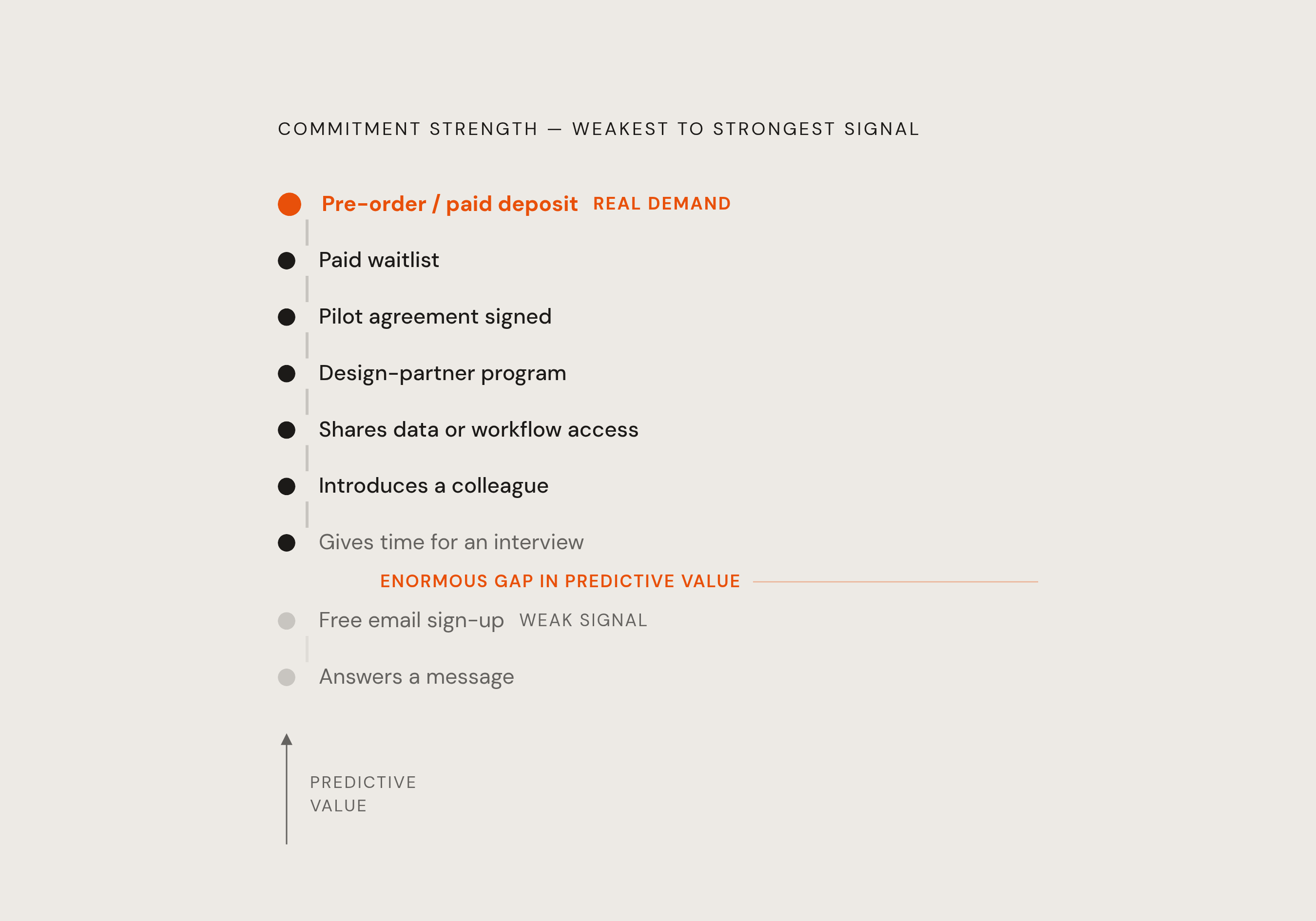
Every form of validation short of a financial commitment can be rationalized away. A founder can talk themselves into believing a polite interview answer or a flattering comment means something. Money can't be explained away the same way, and that makes willingness to pay, or a concrete escalating commitment toward it, the only proof of demand that holds up under scrutiny. Commitments run along a ladder, and where a prospect lands on it predicts how real the demand actually is. Answering a message is near the bottom. Giving time for an interview sits above that. Introducing a colleague, sharing sample data or workflow access, joining a design-partner program, signing a pilot agreement, and finally paying a deposit or subscription each represent a meaningfully stronger signal than the one before it. A free email sign-up sits near the bottom of this ladder, while a paid waitlist or a pre-order sits near the top, and the gap between them in predictive value is enormous. Specificity matters here too: a quote from a real person naming what they would pay, what they currently spend on workarounds, or what the problem costs them in time or money counts as a willingness-to-pay signal. A specific monthly figure offered for a tool that would automate the task counts. "This is so annoying" does not. The pre-sale remains the gold standard of this whole framework, collecting money before building anything, whether through a lifetime deal, a paid beta spot, or an early-bird subscription, because it's the clearest possible proof that the market exists at the price point the business actually needs. Kill criteria belong at the start of this process, not the end. If fewer than a defined fraction of visitors take action after a meaningful volume of traffic, the signal is negative, and the idea should be revised or set aside.
Building a smoke-test landing page that measures intent rather than interest
A smoke-test landing page isn't a marketing exercise. It functions as a measurement instrument, and its design determines how useful or misleading the signal it produces is. The page needs a handful of specific elements to do that job: the customer and the problem described in the customer's own language, the promised outcome, how the solution works in three steps, an honest statement of the current stage, and exactly one action, whether that's requesting access, booking a call, or joining a paid pilot. The headline forces a kind of clarity that's easy to skip otherwise. If the value can't be explained in one sentence, the founder doesn't yet know what the product does, and the page exposes that gap before a single line of code gets written. The call to action should demand real commitment. A Stripe checkout for a pre-order or a paid waitlist entry beats a free email capture by a significant margin as a validation signal, because it asks the visitor to risk something. Traffic needs to be targeted: relevant visitors driven through direct outreach, relevant online communities, or a small test ad campaign, with qualified actions tracked. A low conversion rate is diagnostic. It can point to weak pain, weak copy, the wrong audience, low trust, or too much commitment being asked too early, and each of those has a different fix. Talking to the people who didn't convert matters as much as the conversion number itself. Once a founder has gathered enough evidence that the problem is real and prospects will pay, the traditional next step has been to build a small working version of the product, a process that historically consumed weeks or months. That timeline has collapsed. Platforms like Floot let founders move directly from a validated signal to a live, production app in days, built inside Claude or ChatGPT without writing code, so testing the smallest credible artifact now costs conversation turns.
The concierge test: delivering the outcome manually before automating anything
The concierge test means doing by hand, for a small group, what the product would eventually automate. It exposes edge cases, vocabulary, and constraints that no interview or landing page can surface, and it answers the one question that matters most: does solving this problem actually feel valuable to the person receiving the solution. A founder noticed that small Shopify stores were overwhelmed by "Where is my order?" emails during the holidays. Rather than building anything right away, they posted a manual offer, "I will categorize your emails," on a Shopify forum at a fixed weekly price. Several people signed up immediately, a direct behavioral signal collected before a single line of code existed. The concierge test also produces the clearest possible product specification, because every manual step that turns out slow, error-prone, or hard to repeat at scale marks a feature the eventual product has to handle. The emphasis on narrowing before building matters even more now that the barrier to building has dropped so far. A founder with a tight customer profile and a validated hypothesis can spin up a working product quickly enough that skipping validation to "just build" is harder to justify than it used to be, and the real constraint has shifted from development speed to confidence in the problem itself. Because the gap between validated demand and a live product has narrowed this much, founders can move straight from customer discovery into building a real, working artifact to put in front of prospects: an actual app people can use and pay for. At that point, the only job left is replacing manual labor with software.