Pricing Your First SaaS as a Non-Technical Founder
Non-technical founders often underprice their SaaS due to fear and anchoring.

A non-technical founder can now build a working SaaS app, complete with a backend, a database, user logins, and hosting, in a matter of days. The hard part left after that is figuring out what to charge for it. That shift matters because speed to launch used to be the bottleneck, and now it isn't: the bottleneck has moved downstream, to a decision most founders make in an afternoon and then live with for years. A price set at launch calcifies fast. It shapes who signs up, what they expect from support, how much it costs to acquire the next customer, and how the product gets positioned against everyone else in its category. Pricing moves fast too: the per-seat subscription model that dominated SaaS for a decade is losing ground to usage-based and hybrid structures, so a founder who copies a competitor's pricing page from a few years back may be copying a model the market has already started to abandon. A founder with no finance background and no pricing consultant has to make a genuinely hard strategic call, usually at the exact moment they're most excited about having shipped something.
Three psychological traps that push first-time founders toward the wrong price
First-time founders tend to underprice, and the pattern isn't random. It comes from three predictable mental errors that feel like prudence but work against the business.
The first is fear-based pricing. After weeks of building, the fear of rejection pushes founders to set a low price to reduce friction and get someone, anyone, to say yes. Low prices don't just lower revenue. They filter for the customers most likely to churn, demand the most support, and generate the least revenue relative to what it cost to acquire them.
The second is anchoring to personal budget. Founders price based on what feels reasonable to them personally, not on what the product is worth to the person buying it. A tool that saves a marketing agency three hours a week carries a very different value to that agency than it does to the solo founder who built it and thinks in terms of their own monthly expenses.
The third is competitor-copying in a market that's already pricing wrong. Indie-hacker pricing pages are frequently underpriced for the same psychological reasons described above, so copying one just copies the mistake. The founder ends up competing for the same price-sensitive buyers as everyone else in the niche, while a worse product priced higher might be capturing most of the margin available in that same market.
All three traps share one root cause: the founder is pricing from their own vantage point, cost, fear, or comparison, instead of the buyer's vantage point, which is value received, the problem solved, and the alternatives available. Seeing that root cause is what makes a real framework necessary, rather than something a founder can guess their way into.
What "value metric" means
Before picking a price or building out a tier structure, a founder needs to decide what unit of value the customer is actually paying for. That single decision shapes everything that comes after it, more than the number on the page ever will.
A value metric is whatever scales alongside the benefit the customer gets. If the product's value comes from team access, the metric is per seat. If the value comes from a project or a business unit, the metric is per workspace. If the value is something consumed rather than something accessed, a document processed, an API call made, an outcome generated, the metric should track that consumption directly.
Picture a tool that saves an HR manager several hours a month by automating a task they used to do by hand. The value here is time saved, not how many people at the company happen to log in. Pricing that tool per seat misses the thing customers are actually paying for.
Getting this wrong creates a structural mismatch that's hard to undo later. Charge per seat for a product where one person now supervises several AI agents and automated workflows, and the customer getting the most value out of the product pays exactly the same as the customer barely using it. That setup punishes efficiency and puts a ceiling on how much revenue the founder can ever capture from a growing account. Get the value metric right, and the customer's bill rises naturally as their success grows, without anyone needing to have an awkward price-increase conversation. A useful test: if a customer doubles the value they get from the product, does their bill double too? If the answer is no, the value metric needs rethinking.
For most first SaaS products, the real decision sits among three options: per-seat, for team tools where access itself is the unit of value; per-workspace or per-project, where the customer's business or project is the unit; and hybrid, a base platform fee combined with a usage meter for AI features, API calls, or automated tasks. The value metric also decides what pricing model is even honest to offer. A flat unlimited plan can't survive contact with AI token or compute costs that scale with usage, because the founder ends up either losing money on heavy users or overcharging the light ones.
Hybrid Pricing for AI-Enabled Products
Five pricing models cover almost every SaaS product on the market, and each fits a different kind of value metric. Flat-rate charges one price for everything, which works for a simple micro-SaaS with a fairly uniform customer base but leaves expansion revenue on the table as customers grow. Per-seat charges by user per month, and it's the right fit for team collaboration tools where every person logs in and uses the product, though it comes under real pressure once a single person can direct several AI agents and get the output of a much larger team. Usage-based pricing charges for what gets consumed, which lines cost up tightly with value delivered but introduces revenue volatility and the risk of bill shock, which can scare off buyers who need predictable monthly budgets. Tiered pricing, three or four plans gated by feature, is the most common model in B2B software and works well whenever customers fall into clearly distinct segments with different needs. Freemium offers a free tier forever alongside a paid upgrade, and it earns its place in product-led growth strategies built around network effects, though it's a dangerous choice for a solo founder in year one who can't afford to support a large base of non-paying users.
For most SaaS products built in 2026, especially ones with AI features, hybrid is the right default: a predictable base subscription combined with a variable component tied to usage. AI features carry real costs, tokens, compute, API calls, that scale directly with how much a customer uses the product. A flat unlimited plan either loses money on the heaviest users or overcharges the lightest ones. A hybrid structure solves this by charging a base platform fee that covers access, support, and standard functionality, with a metered charge that kicks in above an included usage allowance. That structure also resolves a tension on the buyer's side: finance teams want a known minimum monthly cost, while product teams only want to pay more when they're getting more out of the tool. A base fee plus usage overage gives both sides what they need.
For a first SaaS product, pure usage-based pricing is usually too complicated to set up correctly and too unpredictable to forecast against. Pure per-seat pricing is increasingly out of step with how AI products actually create value. Hybrid pricing built around a simple, understandable meter, documents processed, tasks automated, reports generated, is the practical middle path. A base platform fee covers workspace access and a defined allowance of usage, a per-unit charge applies to anything above that allowance, and a monthly spend cap ensures a customer never opens a bill they weren't expecting. Bill shock is the single biggest reason buyers resist usage-based and hybrid pricing in the first place, and a spend cap removes that risk.
Finding What Customers Will Actually Pay
A price point isn't something to calculate from costs or guess from instinct. It gets discovered through direct conversation with the people who will actually pay it, and skipping that conversation means setting a number in a vacuum.
Return to the HR manager example: if the tool saves several hours of work a month, and that time carries a real dollar value to the business, the tool is creating meaningful monthly value well before any price gets attached to it. A price set well below that value is a bargain the customer would pay without hesitation, and a founder who underprices here is simply leaving most of that value on the table unclaimed.
The willingness-to-pay survey gives a concrete way to find the right range before launch. Ask a sample of target customers two questions: at what price does this become too expensive, and at what price does this become so cheap it makes you question the quality? The space between those two answers is the viable pricing corridor, and five real conversations with target customers can surface it, no formal research project required.
There's also a simple gut check available at the moment of quoting a price out loud. If a founder can't say the number to a potential customer without apologizing for it or immediately offering a discount, that discomfort is usually a signal the price is appropriately ambitious, not that it's too high.
Competitor pricing is worth a glance, but it only tells a founder where the market floor sits, not where the ceiling is. It shows what buyers have already accepted from existing products. It says nothing about what the same buyers would pay for something that solves their problem meaningfully better, or serves a narrower segment with more precision.
Structuring Three Tiers So the Middle One Sells Itself
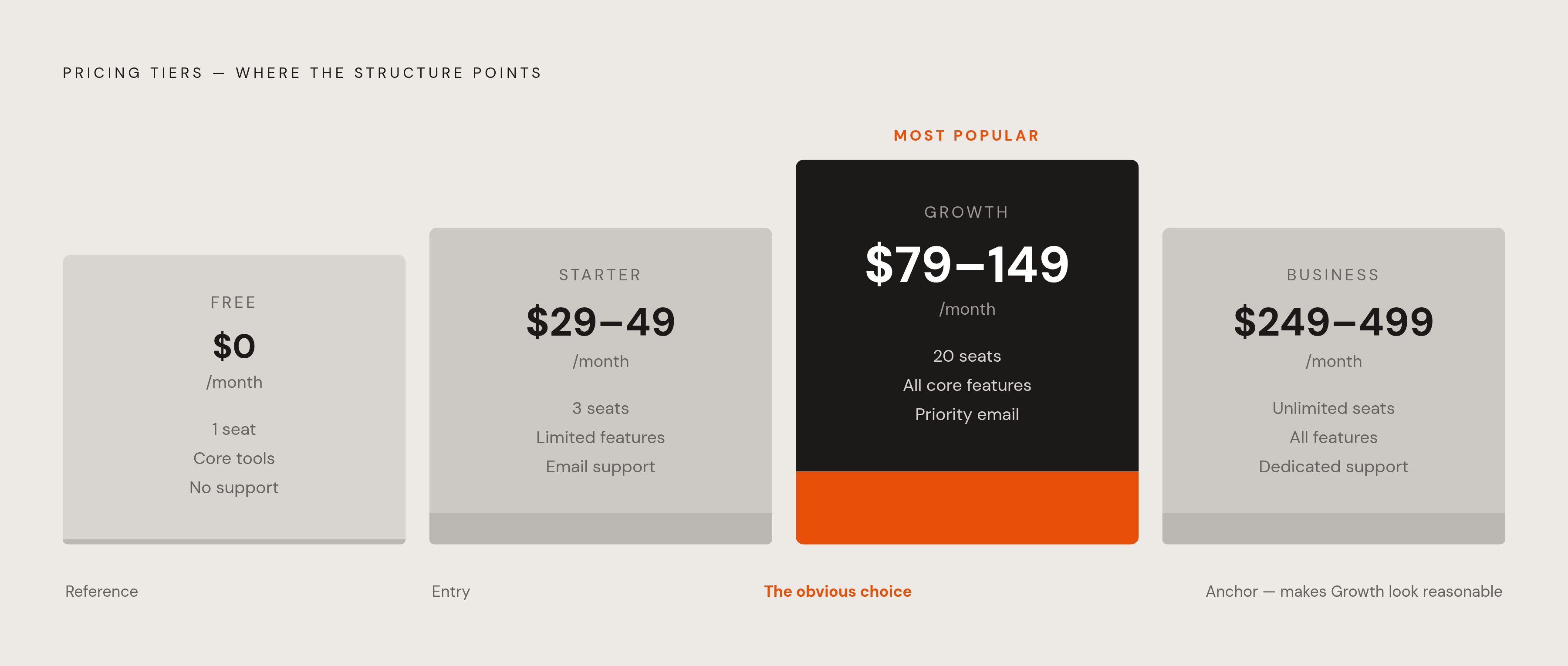
A three-tier pricing page doesn't work because it offers three prices. It works because the contrast between the tiers makes the middle option feel like the obvious, rational choice, and a founder can design that contrast on purpose. The structure that tends to convert puts a clearly limited entry plan on the left, a middle plan marked "Most Popular" that strips away the most common limitations of the entry tier, and a premium plan on the right built for power users, with the whole layout arranged so the middle plan reads as the safe, smart upgrade.
At the dollar amounts that tend to work at indie SaaS scale, a Starter plan runs $29 to $49 a month, with limited seats or features aimed at solo users, offering enough to get real work done while making its constraints visible. A Growth plan runs $79 to $149 a month, carries the "Most Popular" or "Best Value" label, removes the limitations that bother most buyers, and ends up being the right fit for the typical customer. A Business plan runs $249 to $499 a month, with unlimited features and priority support built for power users and small teams, and its main job on the page is to make the Growth plan look like a bargain by comparison.
A free entry-level plan serves as a reference point on the page, not a source of revenue. It needs to be credible enough that a visitor takes it seriously, and constrained enough that most serious buyers move past it to Growth. That's a different instrument than a free-forever tier, which exists to attract non-paying users in hopes they eventually convert or bring in others through network effects. Freemium earns its place in that kind of product-led growth strategy, but for a solo founder running a micro-SaaS in its first year, supporting a large base of non-paying users is a cost most businesses can't absorb yet.
Annual plans reduce churn in a meaningful way, which makes them worth building into the page from day one. Present the annual price as the default option on the pricing page, offer two months free for paying annually (the equivalent of a 17% discount), and show customers the monthly equivalent of that annual price. A concrete dollar figure communicates the saving far more clearly to a buyer than a percentage does.
The True Cost of Launching and Sustainable Prices
A price that covers a product's visible costs at launch often fails to cover what it actually costs to run the business once it has real customers on it, and a founder who doesn't model that gap in advance builds a growth trap directly into the pricing from day one.
The build itself looks deceptively cheap at the start. An AI app builder costs a modest monthly subscription, and a motivated non-technical founder can have paying customers within days of starting. The real cost sits in the infrastructure and security work required before that app can be trusted with data that actually matters. A scan looked at 66 live apps built with AI tools and found that a significant share of the ones built on a popular backend platform had at least one database table that an unauthenticated user could read. It's a missing database policy, and fixing it properly ranges from a quick, low-cost check to a substantial hardening effort depending on how much the app has already grown.
Platform lock-in adds a second hidden cost down the line. Rebuilding a no-code app that has outgrown the platform it was built on is a serious development project, in both time and money, and a founder who priced at the thinnest possible margin has no budget left when that rebuild becomes necessary.
Payment processing adds a real, recurring cost to every single transaction. Standard card processing, billing, and optional tax handling through a processor like Stripe together take a meaningful cut of each transaction, and that cut compounds hardest at low price points. A $29/month plan loses a disproportionate share of its revenue to processing fees compared to a $49/month plan, simply because the fixed-cost portion of the fee is the same regardless of the price.
Automation and integration tools add their own ongoing cost. A founder stitching together several separate services to replicate what a single all-in-one platform would otherwise handle ends up paying a recurring monthly fee per connection, and those costs stack up as the product and its workflows grow. Pricing that accounts for all three layers, infrastructure and security, platform lock-in, and the quiet cost of the tools running behind the product, is sustainable pricing; otherwise it's a number that happens to work until the business starts succeeding.