When to Hire a Developer After Launching a No-Code App
Know which signals mean your no-code foundation still works and which mean it's holding you back.

Founders tend to treat hiring a developer as a milestone, a chapter that's supposed to start once the product feels real enough. That framing causes most of the damage. Hiring too early burns through cash on a direction nobody outside the founding team has confirmed works. Hiring too late means months of patched-together workarounds while competitors move faster during the exact window when speed decides who wins the customer. The usual advice, build with no-code first and bring in a developer later, tells founders what order to follow but gives them nothing to check their situation against. What's missing is a way to read the specific conditions in front of them: which signals mean the no-code foundation still works, and which mean it has already turned into the thing holding the product back.
What no-code foundations genuinely handle well
No-code covers far more ground than founders expect once someone tells them "you'll eventually need to rebuild this." Modern no-code and AI-assisted platforms already handle user authentication, subscription billing, workflow automation, multi-user dashboards, API integrations, and AI-powered features without a line of custom code. Those are the standard parts of a working SaaS product, not shortcuts around it.
Certain categories belong to no-code outright: internal tools, admin panels, marketing sites, customer portals, appointment booking systems, simple workflow automation, and early-stage MVPs built to test demand rather than scale it.
Floot, as one example of how far a no-code stack now reaches, runs as a connector inside Claude or ChatGPT and handles backend logic, database storage, user authentication, recurring tasks, email notifications, SEO, and hosting as part of the platform itself. A non-technical founder can describe an app in a single conversation and get a live, production-grade product out the other end, and thousands of apps have already been built this way. It's running infrastructure, not a demo stitched together to look functional.
The honest test for whether to stay on no-code has nothing to do with how sophisticated the software looks. It comes down to where the product's actual edge sits. If what makes the business different is the content, the brand, the way it reaches customers, or the relationships it builds with them, rather than something unique in the software's underlying logic, no-code keeps winning on both cost and speed. Most products, at the early stage, fit that description.
The structural limits that are real, not just inconveniences to work around
No-code has real ceilings, and the skill worth building is telling which ceiling applies to a given product rather than reacting to every friction point as if it were one.
Customization depth is where the first limit appears. No-code tools are built around general use cases, and once a business needs a genuinely custom algorithm, an unusual workflow rule, or a compliance requirement specific to its industry, visual builders start requiring workarounds that get uglier each time another condition gets added.
The second limit is performance under real load. No-code routing adds a layer of processing overhead that stays hidden until users expect fast, multi-step responses from an agentic feature. That's one place where even well-built no-code platforms begin to strain: tools designed for broad, general use add a routing cost that becomes noticeable the moment a product needs high-frequency data operations or multi-step logic running in real time. Treat it as a threshold to watch rather than a reason to assume custom code automatically.
The third limit is integration complexity. Basic integrations, connecting a payment processor or sending data to a spreadsheet, are well handled by nearly every platform on the market. The trouble starts when a workflow needs live data moving between several systems at once (a CRM, a billing tool, an analytics platform, a custom API) with conditional logic deciding what happens between them. That kind of orchestration is where most visual builders stop being able to help cleanly.
The fourth limit sits at the enterprise compliance and security level. Single sign-on, audit logs, data residency guarantees, HIPAA, PCI-DSS: these aren't settings to toggle on. They involve certifications and architectural choices that fall outside what no-code platforms are built to offer by default.
The cost picture that changes as the product scales
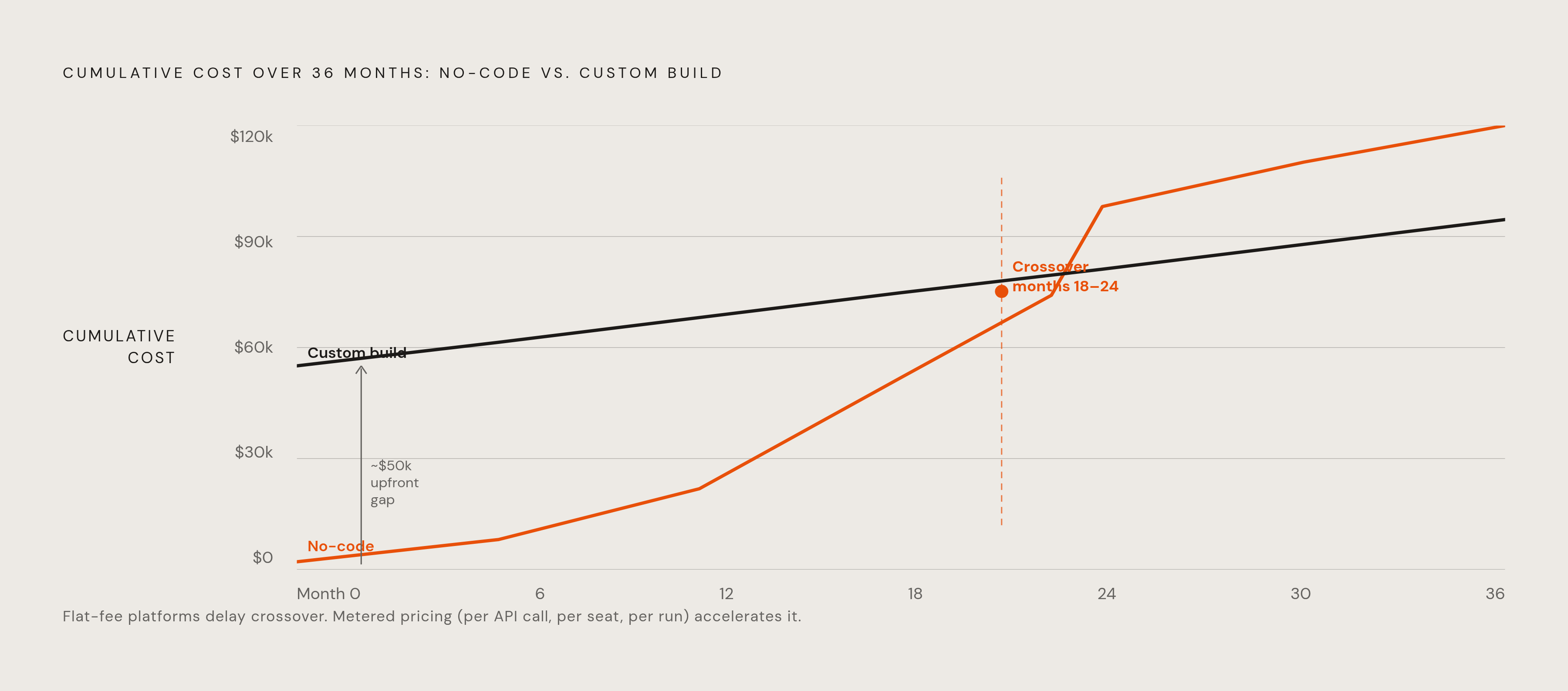
No-code is cheap to start and expensive to keep running at scale, and the point where those two facts cross is more predictable than most founders assume. Building a no-code MVP typically costs between $0 and $5,000. A custom-built MVP costs tens of thousands more before it ever reaches a customer. That gap at the starting line is the entire reason no-code exists as a first step: it lets a founder test whether anyone wants the product before spending real engineering money finding out.
The economics change direction further out. Metered fees, the cost of being locked into one platform's ecosystem, and the eventual expense of rebuilding the product properly all stack up, and by month 18 to 24, the running total on the no-code side typically overtakes what a custom build would have cost across the same 36 months. Revenue, not time on the calendar, is the right gate for deciding when to act on that. Paying for custom development before the product earns meaningful monthly recurring revenue is a bet on an idea nobody's confirmed yet. Paying for it once revenue is real and growing is a calculated investment with a return someone can actually estimate.
Pricing structure changes how fast that crossover arrives. Most no-code platforms charge by metering: every API call, every workflow run, every added user seat adds to the bill, so costs climb in step with usage. Flat, predictable pricing changes that math. A platform charging one fixed monthly fee instead of billing per action delays the point where no-code stops being the cheaper option. That's the model Floot is built around: flat monthly tiers with set limits on actions and AI credits, rather than charges that scale with every operation a founder runs, so founders can keep building on a predictable budget for longer before the hiring decision becomes urgent.
The specific signals that mean your no-code foundation has become a constraint
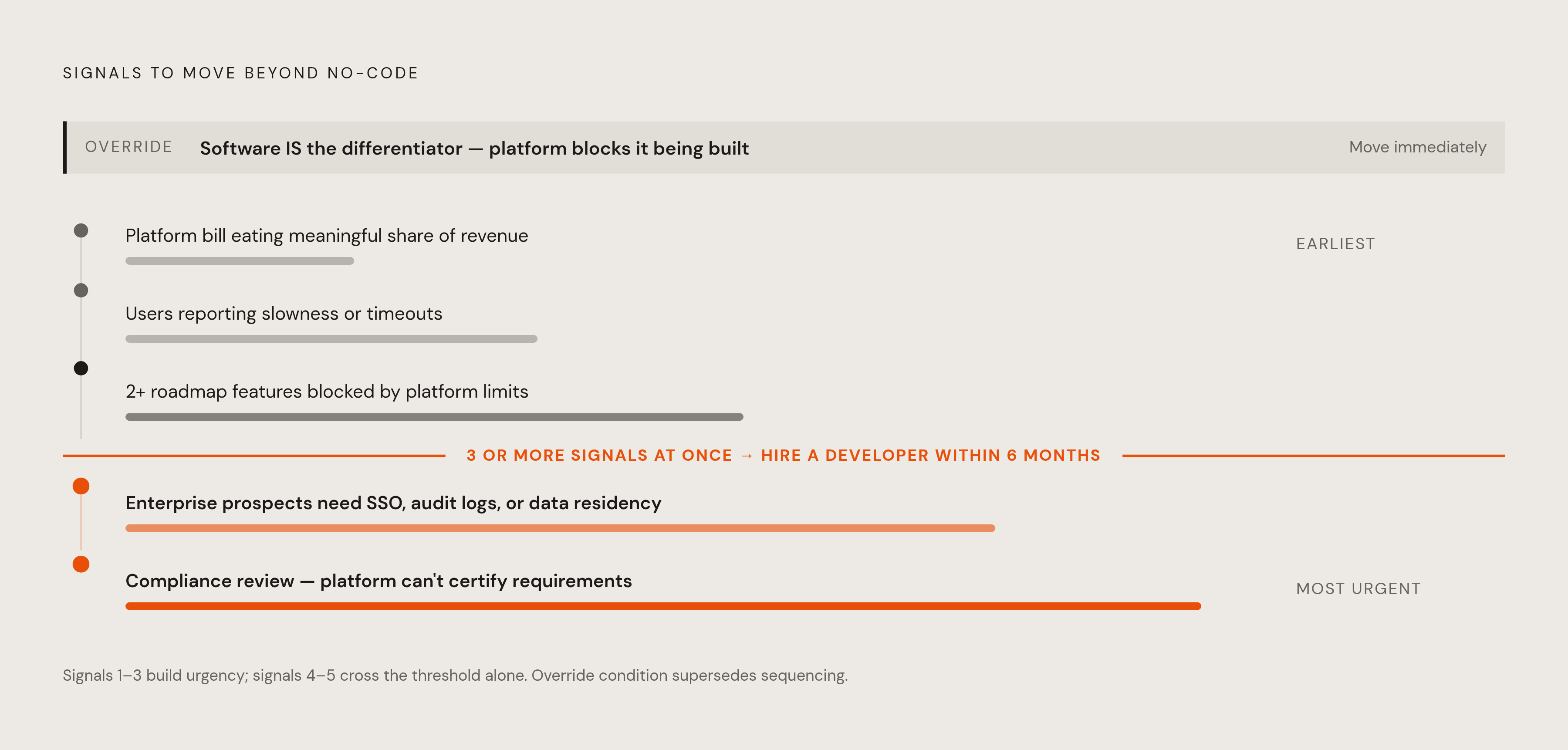
A short list of concrete signals gives a founder something to check the timing against. Each one is something a founder can actually observe, not a feeling about growth or ambition.
The first signal is cost. When the monthly platform bill starts eating a meaningful share of revenue, the cost advantage no-code offered at the start has already flipped, and custom infrastructure would likely pay for itself from that point forward.
Support tickets reveal the second signal. When users start reporting slowness or timeouts on actions that should feel instant, the platform's processing overhead has stopped being a background technical detail and started being a problem customers notice.
The third signal is a stalled roadmap. When two or more planned features can't ship because the platform's logic won't support them, the tool's limits are deciding the product's direction.
The fourth signal appears in sales conversations with larger customers. A prospect asking about single sign-on, audit logs, or data residency, features the platform simply can't offer, is blocking revenue right now, not a future concern to note and revisit.
The fifth signal comes from compliance review, internal or external. When that review turns up requirements the platform can't document or certify, it exposes the business to real risk, not just a technical inconvenience.
Any one of these signals on its own is worth watching. When three or more show up at the same time, the right move is to plan a developer hire or a custom rebuild within six months, not to wait and see if the pressure eases.
One signal overrides the rest of the list entirely: if the software itself is what makes the business hard to copy, the product experience, the user interface, the integrations unique to it, and the no-code platform is actively preventing that differentiator from getting built, it settles the question.
Checking whether a given constraint is a genuine structural limit or just a gap specific to the platform in use should come before acting on any of this. A platform that already manages backend, database, and hosting from day one removes an entire category of false alarms that founders using tools which leave infrastructure entirely in their own hands tend to run into.
The signals that mean you should stay on no-code
Just as many signals that feel like "time to hire a developer" are really signals to fix something else: a workflow, a process, or a platform choice, not the foundation itself. Telling the two apart is what keeps a founder from spending money they didn't need to spend.
Slow feature iteration is usually a sign of messy requirements or disorganized logic inside the builder, not a platform ceiling. A developer won't fix unclear thinking about what the product should do; clearer planning will.
Frustration with the tool itself doesn't mean customers are unhappy. A founder who finds the visual builder clunky to work in, while users report no problems with the product, doesn't have a developer problem. That's a workflow complaint, not a product one.
An idea that hasn't been validated yet is never a reason to hire, no matter how much revenue is sitting in the bank. Paying for custom development before demand is proven is still a gamble, and the entire value of starting on no-code was reducing that exact risk.
Hearing "this won't scale" in an early sales conversation or investor meeting is usually premature. The scaling problems that actually justify custom development appear as specific, observable thresholds, like the five signals above, measured after the product has real users to stress-test it, not as a worry raised beforehand.
A competitor launching something similar isn't a reason to rebuild either. At the validation stage, the ability to iterate fast on a no-code platform is the advantage, not the liability. Rebuilding in response to competitive fear, before the signals actually appear, trades that speed away for nothing.
Matching developer hires to signals
Once the real signals are confirmed, the next mistake to avoid is hiring the wrong shape of help. Matching the type of hire to the type of signal keeps a founder from overspending on more engineering than the problem actually calls for.
Freelancers fit narrow, well-defined problems: a single integration the platform can't support, one specific performance bottleneck, a compliance certification needed for one regulated feature. These are scoped jobs with limited moving parts, and a freelancer can usually close them without the overhead of hiring a full team.
Agencies or small product teams fit problems that touch the architecture itself. When the platform's limits affect how data is structured, how core workflows are designed, or the product experience at its center rather than one isolated feature, that kind of rebuild needs people thinking about the whole system, not just one piece of it.
In-house developers make sense only once engineering needs are clearly ongoing and open-ended: product complexity that keeps expanding, a team large enough to need technical management, and revenue steady enough to support a full-time salary. Products still pre-revenue almost never meet that bar, and bringing on a full-time hire before they do usually just adds payroll to the list of things slowing the business down.
The most common answer for most founders reading this is a hybrid approach, where custom development covers the differentiator, the product logic and integrations that make the business hard to copy, while no-code keeps running everything else: the admin panel, the marketing site, the internal dashboards. That split fits a product that's hit specific ceilings in specific places, not one that's failed across the board. Before any of these hires happen, getting the scope clearly defined matters more than the hire itself. Vague requirements lead to proposals that don't match the real problem, the wrong platform getting picked for the job, and products that end up needing a second rebuild because nobody was specific enough the first time.
Applying this framework before the signals become expensive
The founders who handle this decision well check the signals on a schedule, before a crisis forces the decision for them. A quarterly review against the five signals, cost as a share of revenue, performance complaints in support tickets, roadmap items blocked by platform limits, compliance walls in enterprise sales conversations, and unanswered questions from compliance review, catches the crossover point while there's still time to plan for it calmly.
The purpose of that check is to confirm that the current foundation is still the fastest, cheapest, most reliable way to reach the next milestone, and to notice the moment it stops being that.
The choice of infrastructure underneath the product affects how long that foundation holds. A platform that includes backend, database, hosting, authentication, and integrations from the start, and charges a flat fee rather than metering every action, pushes the cost crossover further out and keeps false alarms from triggering a hiring decision too soon. Floot was built around that exact position: non-technical founders running production-quality infrastructure inside the AI tools they already use, Claude and ChatGPT, without managing a separate stack, without unpredictable per-token bills, and without stitching together a patchwork of outside services that each bring their own limits. Founders building on that kind of foundation reach the real signals, when they finally show up, with a validated product and real revenue behind them, not an unfinished prototype and a pile of technical debt.
The real value of this framework is the control it hands back to the founder. A founder can hire a developer on their own schedule, backed by evidence instead of guesswork, at the moment that actually calls for it.